Cricket Fielding Positions Explained for Beginners
A beginner's guide to cricket fielding positions: the off side and leg side, where the main fielders stand and what words such as silly, deep and fine mean.
Bitdeposit · 24 November 2026 · 8 min read
On this page
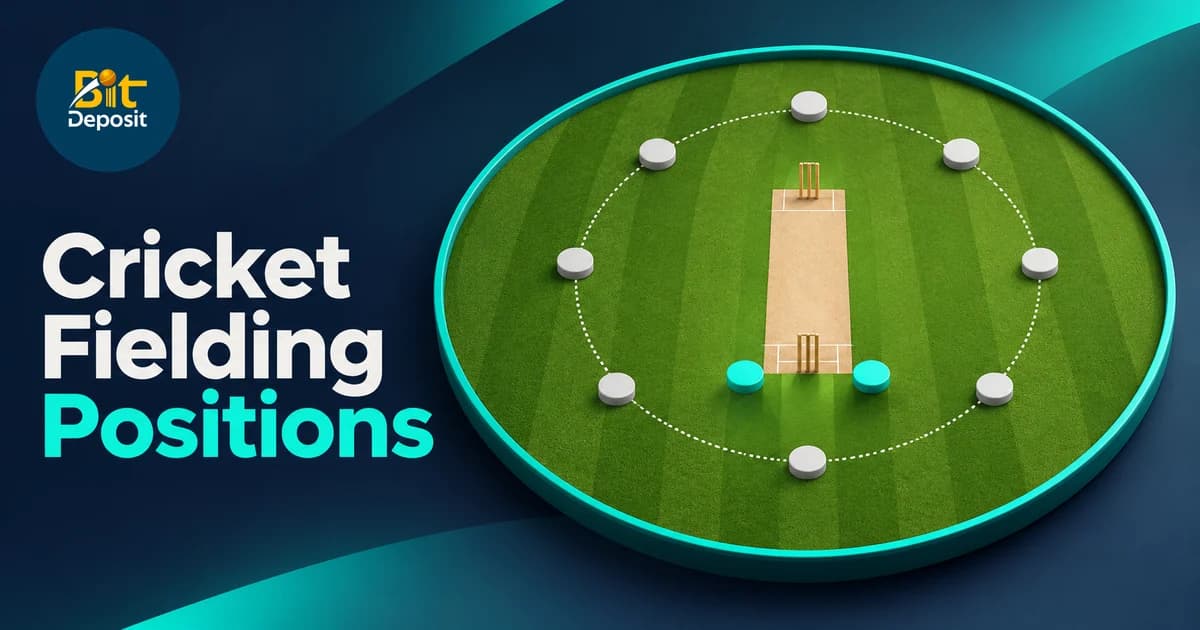
Cricket fielding positions are the named places where the nine fielders stand, apart from the bowler and the wicketkeeper. Each name describes the side of the field, the angle from the batter and the distance from the bat. This guide explains the off side and leg side, the main positions and the limits on field placings.
Key takeaways
- A fielding side has 11 players: the bowler, the wicketkeeper and 9 fielders for the captain to place.
- The off side is the side the batter's chest faces in the batting stance, and the leg side, or on side, is behind the batter's back.
- No more than two fielders may be behind square on the leg side when the ball is bowled.
What are cricket fielding positions?
Cricket fielding positions are the named spots on the field where the fielding side's players stand to stop runs and take catches. There are more than 30 names, far more than there are fielders.
A team has 11 players on the field. One is the bowler. One is the wicketkeeper, a fielder who stands behind the striker's wicket to collect the ball and is the only fielder allowed to wear gloves. That leaves 9 fielders, and the captain chooses where each one stands.
How do cricket fielding positions work?
Cricket fielding positions work by dividing the field into two halves, the off side and the leg side, and naming each spot by its angle and distance from the batter.
The off side is the half of the field that the batter's chest faces in the normal side-on stance. The leg side, also called the on side, is the half behind the batter's back and legs. For a right-handed batter looking at the bowler, the off side is to the batter's right and the leg side is to the left. For a left-handed batter everything is mirrored.
Several words adjust the name of a position:
- Silly means very close to the batter.
- Short means closer to the batter than the standard position.
- Deep, or long, means on or near the boundary.
- Square means level with the batter's crease, at a right angle to the pitch.
- Fine means at a narrow angle behind the batter, close to the line of the pitch.
- Backward means a little behind square, towards the wicketkeeper's end.
- Forward means a little in front of square, towards the bowler's end.
In a worked example, a fast bowler in a Test match has three slips, a gully, point, cover and mid-off on the off side. That is 3 + 1 + 1 + 1 + 1 = 7 fielders. Mid-on and fine leg stand on the leg side, which is 2 fielders. The total is 7 + 2 = 9, and commentators call this a 7-2 field.
What are the main cricket fielding positions?
The main cricket fielding positions are the 15 in the table, described for a right-handed batter.
| Position | Where the fielder stands | Main job |
|---|---|---|
| Slip | Off side, beside the wicketkeeper | Catch edges |
| Gully | Off side, wider than the slips | Catch thick edges |
| Point | Off side, square of the batter | Stop cut shots |
| Silly point | Off side, square and very close | Catch balls off bat and pad |
| Cover | Off side, between point and mid-off | Stop drives |
| Mid-off | Off side, near the bowler | Stop straight drives |
| Long-off | Off side boundary, behind mid-off | Catch lofted straight hits |
| Third man | Off side boundary, behind the slips | Stop edges and late cuts |
| Mid-on | Leg side, near the bowler | Stop straight drives |
| Long-on | Leg side boundary, behind mid-on | Catch lofted straight hits |
| Midwicket | Leg side, between mid-on and square leg | Stop flicks and pulls |
| Square leg | Leg side, square of the batter | Stop pulls and sweeps |
| Deep square leg | Leg side boundary, square | Catch hooks and pulls |
| Short leg | Leg side, close to the batter | Catch balls off bat and pad |
| Fine leg | Leg side boundary, behind square | Stop glances and top edges |
What are the fielding restrictions in cricket?
The fielding restrictions in cricket are limits on where fielders may stand, set by the Laws of Cricket and by each competition. One rule applies in every format: at the instant of delivery, no more than two fielders, other than the wicketkeeper, may be behind the popping crease on the leg side. The popping crease is the line in front of the stumps that marks the batter's ground. A breach is called a no-ball.
Limited-overs cricket adds a fielding circle, which is a ring marked 30 yards (27.43 metres) from the pitch. A powerplay is a block of overs in which only a small number of fielders may stand outside that circle. In men's international cricket, the usual limit is 2 fielders outside the circle during the first 10 overs of a One Day International and the first 6 overs of a Twenty20 match. More are allowed later in the innings. The numbers differ between competitions. Test cricket has no fielding circle.
How do you read a field setting step by step?
A field setting is read by splitting the field into off side and leg side and counting the fielders in each. Follow these steps:
- Check whether the batter on strike is right-handed or left-handed.
- Find the wicketkeeper and count the slips.
- Split the field down the line of the pitch into off side and leg side.
- Count the fielders on each side, such as 7-2, 6-3 or 5-4.
- Count the fielders outside the circle in a limited-overs match.
- Check that no more than two fielders are behind square on the leg side.
Several slips suggest the bowler wants edges, and several boundary fielders suggest the aim is to limit fours and sixes. A field does not predict the next ball.
Common mistakes to avoid
- Fixing off and leg to one side of the ground. The two sides swap when a left-handed batter takes strike.
- Counting 11 fielders to place. The bowler and the wicketkeeper are fixed, which leaves 9.
- Mixing up third man and fine leg. Third man is on the off side and fine leg is on the leg side.
Frequently asked questions
How many fielding positions are there in cricket?
There are more than 30 named fielding positions in cricket, but only 9 fielders to fill them. A team has 11 players on the field, and two of them are the bowler and the wicketkeeper. The captain chooses which positions to use.
What is the difference between off side and leg side in cricket?
The off side is the half of the field that the batter's chest faces in the batting stance, and the leg side is the half behind the batter's back. For a right-handed batter looking at the bowler, the off side is to the right.
Why is it called silly point?
Silly point gets its name from how close the fielder stands to the bat. In fielding names, silly means very near the batter, and the usual explanation is that standing so close to a hard ball looked foolish. Close fielders usually wear a helmet.
How many fielders can be behind square on the leg side?
No more than two fielders, apart from the wicketkeeper, can be behind square on the leg side at the instant the ball is bowled. If a third fielder is there, the umpire calls a no-ball, which adds one run to the batting side's score.
What is the difference between third man and fine leg?
Third man and fine leg are both positions behind the batter, usually near the boundary, but on opposite sides of the field. Third man is on the off side, behind the slips. Fine leg is on the leg side and stops glances.
Play responsibly
A field setting shows a plan, not a result, so it is not a reliable guide for a bet on the next ball. Set a budget and a time limit before a match, and do not chase a losing bet with another. Betting is for adults only and is not legal everywhere, so check the law where you live. Help is available from GambleAware.
Summary
- A fielding side has a bowler, a wicketkeeper and 9 fielders placed by the captain.
- The off side is in front of the batter's chest and the leg side is behind the batter's back.
- No more than two fielders may be behind square on the leg side, and limited-overs cricket adds powerplay limits.
The official wording is in the MCC Laws of Cricket. The limits on boundary fielders are covered in cricket powerplay rules, and the penalty for an illegal field in no-ball and wide rules in cricket. The formats are compared in T20 vs ODI vs Test cricket.
18+ only. Play for fun, set your limits and take a break when it stops being fun.
Share this post