No-Ball and Wide Rules in Cricket Explained for Beginners
A beginner's guide to no-ball and wide rules in cricket: what makes a delivery illegal, the penalty runs, the free hit and how a batter can still be out.
Bitdeposit · ২৩ নভেম্বর, ২০২৬ · 8 মিনিটে পড়া
এই পেজে যা আছে
The no ball rules in cricket penalise an illegal delivery: the batting side gets 1 run, the ball is bowled again and, in limited-overs cricket, the next ball is a free hit. A wide is a ball bowled out of the batter's reach. This guide covers both rules, a worked over and bet settlement.
Key takeaways
- A no-ball is an illegal delivery under Law 21 of the Laws of Cricket, and a wide is a ball out of the batter's reach under Law 22.
- A no-ball or a wide gives the batting side 1 penalty run plus any runs scored, and it is bowled again.
- In limited-overs cricket the delivery after a no-ball is a free hit.
- Off a no-ball a batter can be out only run out, obstructing the field or hit the ball twice.
What is a no-ball in cricket?
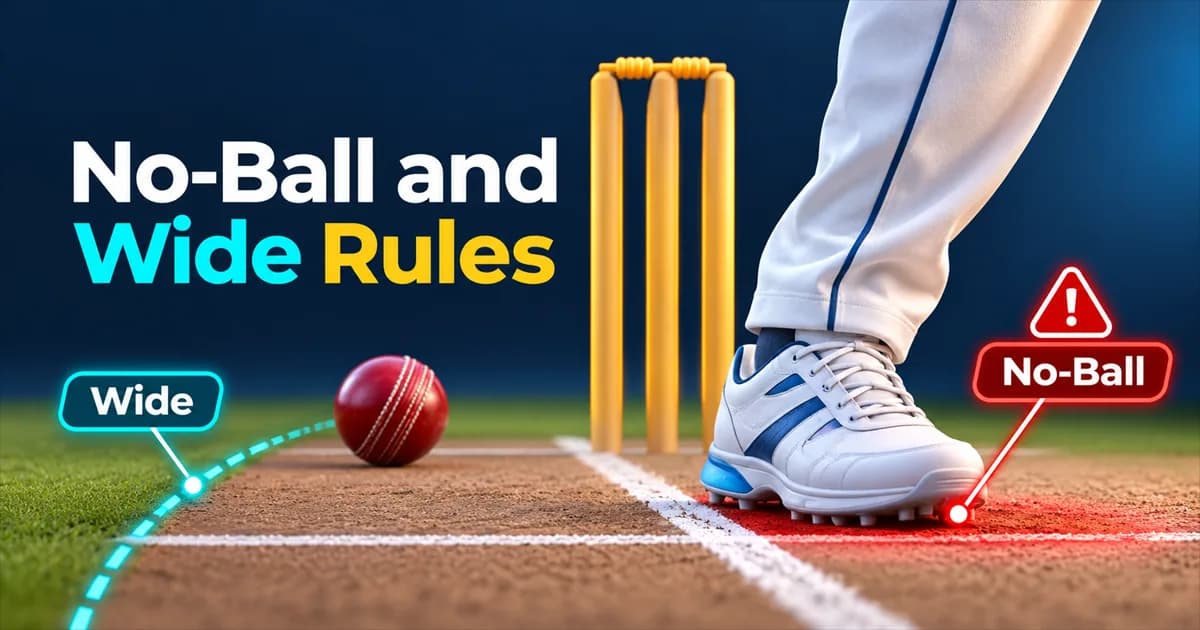
A no-ball is a delivery that breaks the rules on how or from where the ball is bowled, so the umpire awards 1 run to the batting side. The Laws of Cricket, written by the Marylebone Cricket Club (MCC), list these main causes:
- Front foot: some part of the bowler's front foot must land behind the popping crease, the line 4 feet (1.22 metres) in front of the stumps.
- Back foot: the back foot must land inside the return crease at the side, without touching it.
- High full toss: a ball that passes above the batter's waist without bouncing.
- Over head height: a ball that bounces and passes over the head of the batter standing upright.
- Throwing: the bowler's arm must not straighten during the delivery swing.
- Bounce: a ball that bounces more than once, rolls along the ground or lands off the pitch.
- Fielding breaches: for example, too many fielders outside the circle in limited-overs cricket.
Competitions add their own details. Many professional playing conditions call a ball over head height a wide instead of a no-ball, and they limit the number of short balls allowed in each over.
What is a wide in cricket?
A wide is a delivery that passes so far from the batter that it cannot be hit with a normal cricket stroke. A ball is not a wide if the batter hits it or moves and brings it within reach.
Limited-overs umpires apply a stricter interpretation than Test umpires. A ball that passes down the leg side behind the batter is usually called a wide, and guide lines on the pitch mark the limit on the off side.
How do no-ball and wide rules work in an over?
No-ball and wide rules add runs and extra deliveries to an over, because an over ends only after 6 legal balls. A worked example from a limited-overs match shows the count.
| Delivery | What happens | Legal ball | Team total |
|---|---|---|---|
| 1 | Single | 1 | 1 |
| 2 | Wide | Not counted | 2 |
| 3 | Four | 2 | 6 |
| 4 | No-ball, batter runs 2 | Not counted | 9 |
| 5 | Free hit, six | 3 | 15 |
| 6 | No run | 4 | 15 |
| 7 | Single | 5 | 16 |
| 8 | No run | 6 | 16 |
The bowler delivers 8 balls to complete 6 legal ones. Runs off the bat are 1 + 4 + 2 + 6 + 1 = 14. Extras are 1 wide + 1 no-ball = 2. The over costs 14 + 2 = 16 runs.
Delivery 4 shows how a no-ball is scored. The penalty run is an extra and the 2 runs go to the batter, so 1 + 2 = 3 runs are added. Delivery 5 is a free hit because it follows a no-ball.
What is the difference between a no-ball and a wide?
The difference between a no-ball and a wide is that a no-ball is an illegal delivery, while a wide is a legal delivery bowled out of reach. The table compares the two.
| Point | No-ball | Wide |
|---|---|---|
| Cause | Illegal delivery, such as overstepping | Ball out of reach for a normal stroke |
| Runs off the bat | Credited to the batter | Not possible |
| Ball faced by the batter | Yes | No |
| Ways to be out | Run out, obstructing the field, hit the ball twice | Stumped, run out, hit wicket, obstructing the field |
| Free hit next ball | Yes, in limited-overs cricket | No |
A delivery cannot be both: the no-ball call takes priority. A wide that runs to the boundary scores 1 + 4 = 5 wides. A no-ball hit for six adds 1 + 6 = 7 runs to the total. Both are charged to the bowler's figures.
How do you score no-balls and wides?
To score no-balls and wides, add the penalty run first and then deal with the other runs and the over count. Follow these steps:
- Add 1 penalty run to the team total when the umpire signals.
- Credit runs off the bat on a no-ball to the batter, and score all runs on a wide as wides.
- Leave the delivery out of the count of 6 legal balls.
- Mark the next ball as a free hit after a no-ball in limited-overs cricket.
- Check the extras line on the scorecard, where "nb" and "w" are listed.
Extras also affect bet settlement. Team totals and "runs in over" markets usually include every extra, so the 16-run over above beats a line of 10.5. A stake of 100 on over 10.5 runs at odds of 1.85 returns 185. Batter runs markets count only runs off the bat. A total extras market adds wides, no-balls, byes and leg byes. Rules on next-ball markets vary by bookmaker.
Common mistakes to avoid
- Counting a no-ball or wide as a ball in the over. Neither is a legal ball, so the bowler must bowl it again.
- Thinking a batter cannot be out off a wide. A batter can be stumped, run out, hit wicket or out obstructing the field off a wide.
- Expecting a free hit in Test cricket. The free hit comes from limited-overs playing conditions, not from the Laws.
Frequently asked questions
How many runs is a no-ball worth?
A no-ball is worth 1 penalty run under the Laws of Cricket, plus any runs scored from the delivery. A no-ball that the batter hits for four therefore adds 1 + 4 = 5 runs to the team total. Competitions can set a different penalty.
Can you be out off a no-ball?
A batter can be out off a no-ball in only three ways: run out, obstructing the field or hit the ball twice. A batter cannot be bowled, caught, leg before wicket (LBW), stumped or hit wicket from a no-ball. The same limits apply to the free hit that follows.
What is a free hit in cricket?
A free hit is the delivery after a no-ball in limited-overs cricket, on which the batter can be dismissed only in the ways that apply to a no-ball. Test cricket does not use the free hit, and competition playing conditions set the details.
Can a batter be stumped off a wide?
Yes, a batter can be stumped off a wide. The Laws of Cricket allow four dismissals from a wide: stumped, run out, hit wicket and obstructing the field. The 1 penalty run still counts, and a stumping is credited to the bowler.
Do extras count in cricket betting?
Extras usually count in team total, innings runs and "runs in over" markets, because those markets follow the official score. Extras do not count in batter runs markets unless the runs come off the bat. Rules vary by bookmaker, so read the cricket rules first.
Play responsibly
No-balls and wides are unpredictable, so markets on single overs and extras carry a high level of chance. Set a budget before the match and do not chase losses on the next over. Betting is for adults only, and the law differs by country. Support is available from GambleAware.
Summary
- A no-ball is an illegal delivery and a wide is a ball out of the batter's reach.
- Each gives 1 penalty run plus any runs scored and must be bowled again.
- In limited-overs cricket a free hit follows every no-ball.
- Extras count in team totals, but batter markets count only runs off the bat.
The full wording is in the MCC Laws of Cricket. The ways a batter can be out are covered in cricket dismissals explained, and the extras line is shown in how to read a cricket scorecard. The cost of extras to a bowler is covered in strike rate and economy rate explained.
শুধু ১৮+। মজার জন্য খেলুন, নিজের সীমা ঠিক করে নিন, আর মজা না থাকলে বিরতি নিন।
পোস্টটি শেয়ার করুন