DRS in Cricket Explained: Reviews and Umpire's Call
A beginner's guide to DRS in cricket: who can review a decision, the technology the third umpire uses and how umpire's call works in LBW decisions.
Bitdeposit · ২৪ নভেম্বর, ২০২৬ · 8 মিনিটে পড়া
এই পেজে যা আছে
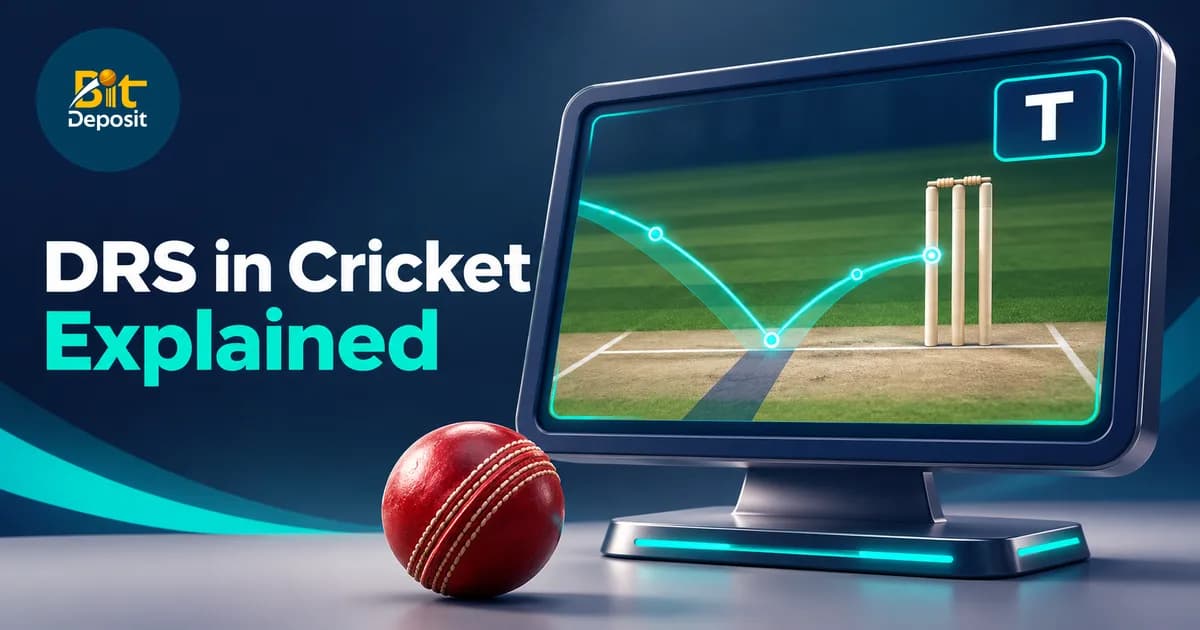
DRS in cricket is the Decision Review System, a process that lets players challenge an on-field umpire's decision with the help of technology. The batter who is given out or the fielding captain asks for a review, and the third umpire checks replays, edge detection and ball tracking. This guide explains reviews, the tools and umpire's call.
Key takeaways
- The Decision Review System (DRS) lets the batter who is given out, or the fielding captain, challenge an on-field decision.
- A review must be requested within 15 seconds by making a T signal with the hands.
- A side keeps its review when the decision is overturned and when the result is umpire's call.
- International sides typically have 3 unsuccessful reviews per innings in Tests and 2 in limited-overs matches, but playing conditions vary by competition.
What is DRS in cricket?
DRS in cricket is the Decision Review System, a set of rules and technology that allows a team to ask the third umpire to check a decision made by the on-field umpires. The third umpire is a match official who sits off the field and studies television replays.
The system was trialled in Test cricket in 2008 and is now part of the International Cricket Council (ICC) playing conditions for international matches. DRS deals mainly with dismissals, which means whether a batter is out or not out.
How does DRS work?
DRS works in three stages: a request from a player, a check by the third umpire and a final signal from the on-field umpire. Only two people can ask for a review: the batter who has been given out, or the captain of the fielding side after a not out decision.
The request must be made within 15 seconds of the ball becoming dead, by making a T signal with the hands. Players on the field may discuss it, but no one may take advice from outside the field.
The third umpire then checks for a no-ball, then for contact with the bat or glove. For leg before wicket (LBW), ball tracking comes last. LBW is a method of dismissal in which the ball hits the batter's body and would have gone on to hit the wicket.
Umpire's call is a ball-tracking result that is too close for the technology to overrule the on-field umpire, so the original decision stands. For an LBW, ball tracking shows three things: where the ball pitched, where it hit the batter (the impact) and whether it would have hit the wicket. Where the ball pitched is treated as a plain fact. On impact and on hitting the wicket, a marginal result is shown as umpire's call, broadly when less than half of the ball is inside the relevant zone.
The same delivery can therefore be out if the umpire said out and not out if the umpire said not out. The reviewing side does not lose its review on umpire's call.
In a worked example, a fielding side in a One Day International (ODI) starts the innings with 2 reviews.
- Over 8: the captain reviews an LBW given not out. Ball tracking shows the ball clipping the leg stump, which is umpire's call. The decision stays not out and the side still has 2 reviews.
- Over 15: the captain reviews a caught behind given not out. Edge detection shows a spike as the ball passes the bat. The decision changes to out and the side still has 2 reviews.
- Over 23: the captain reviews an LBW given not out. Ball tracking shows the ball pitched outside leg stump. The review is unsuccessful, and the side has 2 - 1 = 1 review left.
What technology does DRS use?
DRS uses slow-motion replays, edge detection and ball tracking, and the third umpire judges all of them together. The table shows what each tool checks.
| Tool | What it is | What it checks | Mainly used for |
|---|---|---|---|
| Slow-motion replays | Television pictures from several angles | The bowler's front foot, clean catches, bat or pad first | Every review |
| Edge detection (UltraEdge or Snicko) | Sound from the stump microphone matched to video frames | Whether the ball touched the bat or glove | Caught behind and LBW |
| Ball tracking | Cameras that plot and predict the ball's path | Pitching, impact and hitting the wicket | LBW |
| Third umpire | The off-field official who views the evidence | Whether the evidence supports a change | Every review |
The number of unsuccessful reviews allowed per innings varies by format and competition. In recent ICC playing conditions, a side typically has 3 in a Test innings and 2 in an ODI or Twenty20 International (T20I) innings. Domestic leagues set their own numbers.
What is the difference between a player review and an umpire review?
A player review is a challenge requested by a team, and an umpire review is a check that the on-field umpires request themselves. Only player reviews are limited in number.
Umpire reviews cover decisions that are hard to see at full speed. Typical cases are run outs, stumpings, whether a catch carried to the fielder and whether the ball reached the boundary. An umpire review costs neither side anything.
How do you follow a DRS review step by step?
A DRS review is followed by watching the same checks the third umpire makes, in the same order. Follow these steps:
- Watch for the T signal within 15 seconds of the decision.
- Note the on-field decision, because it stands if the result is marginal.
- Check the front-foot replay, because a no-ball rules out LBW and caught.
- Look at the edge detection for a spike as the ball passes the bat.
- Read the three ball-tracking results for an LBW: pitching, impact and wickets.
- Wait for the on-field umpire to confirm or change the decision.
- Count the reviews the side has left.
Bets on dismissals settle on the final decision after any review, not on the first signal. A stake of 100 on LBW at odds of 5.00 in a method of next dismissal market returns 100 x 5.00 = 500 only if the LBW decision stands.
Common mistakes to avoid
- Thinking umpire's call costs a review. The on-field decision stands, but the reviewing side keeps its review.
- Assuming ball tracking alone decides every LBW. On a marginal result the on-field umpire's decision is the one that counts.
- Believing the number of reviews is the same everywhere. It varies by format and competition.
Frequently asked questions
What does DRS stand for in cricket?
DRS stands for Decision Review System. It is the process that lets the batter who is given out, or the fielding captain, ask the third umpire to check an on-field decision. The third umpire uses replays, edge detection and ball tracking.
What is umpire's call in DRS?
Umpire's call is a ball-tracking result that is too marginal to overturn, so the on-field decision stands. It applies to the impact and hitting the wicket parts of an LBW review, broadly when less than half of the ball is inside the zone. The reviewing side keeps its review.
How many reviews does a team get in cricket?
The number of reviews depends on the format and the competition. In recent ICC playing conditions a side typically has 3 unsuccessful reviews per innings in Tests and 2 in ODIs and T20Is. Successful reviews and umpire's call results are not deducted.
Who can ask for a DRS review?
Only the batter who has been given out or the captain of the fielding side can ask for a DRS review. The request is made with a T signal within 15 seconds. No advice may come from outside the field.
What is UltraEdge in cricket?
UltraEdge is an edge detection tool that matches sound from the stump microphone to slow-motion video. A spike on the sound wave as the ball passes the bat suggests contact. It is used in both caught behind and LBW reviews.
Play responsibly
Review decisions are hard to predict, and betting markets on the next wicket can settle within a few balls, so in-play stakes add up quickly. Set a budget and a time limit before the match, and do not chase a losing bet with another. Betting is for adults only, and the law differs by country, so check the rules where you live. Help is available from GambleAware.
Summary
- DRS lets the batter who is given out, or the fielding captain, challenge an on-field decision within 15 seconds.
- The third umpire checks the no-ball, the edge and then ball tracking, and umpire's call leaves the on-field decision in place without costing a review.
- The number of unsuccessful reviews per innings varies by format and competition.
The Laws that the technology supports are published in the MCC Laws of Cricket. The dismissal most often reviewed is covered in LBW rule explained, and the full list of methods in cricket dismissals explained. Wicket markets are explained in cricket betting markets explained.
শুধু ১৮+। মজার জন্য খেলুন, নিজের সীমা ঠিক করে নিন, আর মজা না থাকলে বিরতি নিন।
পোস্টটি শেয়ার করুন