
What Is Provably Fair? How Crypto Casino Games Are Verified
Bitdeposit · 19 November 2026 · 8 min read
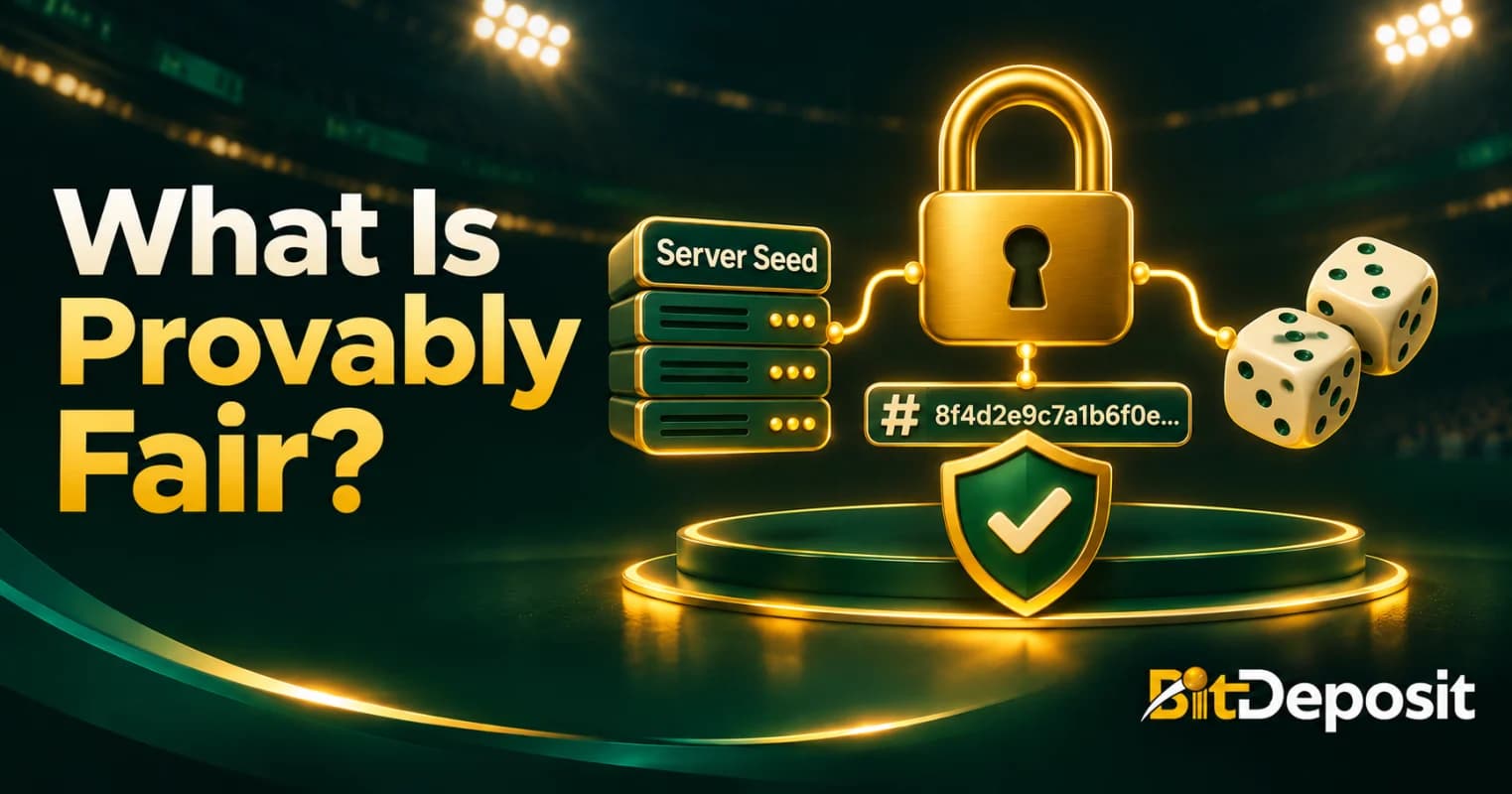
What is provably fair? Provably fair is a method that lets a player check, with cryptography, that a game result was fixed before the bet was placed and was not changed afterwards. It is used mainly in crypto casino games. This guide explains seeds, hashes and verification, and what the method does not prove.
Key takeaways
- Provably fair lets a player verify that a game result was set before the bet and not altered afterwards.
- Each result is calculated from three inputs: a server seed, a client seed and a nonce.
- The casino shows a hash of its server seed before betting, which works as a commitment that can be checked later.
- Provably fair proves that a result was not tampered with: it does not remove the house edge.
What is provably fair?
Provably fair is a verification method in which the inputs that decide a game result are committed to in advance and revealed later, so that the player can recompute the result. It is used mainly for crypto casino games such as crash, dice, mines and plinko.
The method relies on a hash function, which is a formula that turns any data into a fixed-length code. The same input always gives the same output, a tiny change in the input gives a completely different output, and the output cannot practically be reversed to find the input.
How does provably fair work?
Provably fair works by combining a secret value from the casino with a value from the player, after the casino has committed to its secret. A common scheme uses three inputs:
- Server seed. A secret random value generated by the casino. Before betting, the player sees only its hash, usually produced with Secure Hash Algorithm 256 (SHA-256).
- Client seed. A value on the player's side, which the player can change at any time.
- Nonce. A counter of the bets made with that pair of seeds: 0, 1, 2 and so on.
The result of each bet is calculated from the server seed, the client seed and the nonce. The calculation typically uses HMAC-SHA256, a standard way of hashing a message with a secret key. Part of the output is then converted into a game result, such as a dice roll.
The casino cannot choose a convenient server seed, because the hash was shown before it knew the client seed. It cannot swap the seed later either, because a different seed would not match the hash.
A worked example with a dice game shows what is and is not proved. The game turns the hash output into a roll from 0.00 to 99.99, which is 10,000 equally likely results.
- A "roll under 49.50" bet wins on rolls from 0.00 to 49.49, which is 4,950 of 10,000 results, or 49.5%.
- At a 1.00% house edge the payout is 99 / 49.5 = 2.00, so a stake of 100 returns 200.
- The expected return is 0.495 x 200 = 99 for every 100 staked.
The player can prove that each roll was honest. The player still loses 1 per 100 staked on average, because the house edge is built into the payout.
How does provably fair compare with a certified random number generator?
Provably fair differs from a certified random number generator (RNG) mainly in who does the checking. An RNG is the software that produces random results in most online slots and table games. It is normally tested by an independent laboratory, and the player relies on that certificate.
| Question | Provably fair game | Lab-certified RNG game |
|---|---|---|
| Who verifies the results? | The player, or anyone with the seeds | An independent testing laboratory |
| When does checking happen? | After the server seed is revealed, for any past bet | Before release and in periodic audits |
| What can the player check? | Each individual result, by recomputing it | The certificate and the published return to player (RTP) |
| What does the player have to trust? | The published algorithm and the verifier used | The laboratory, the regulator and the operator |
| Where is it common? | Crash, dice, mines and plinko at crypto casinos | Slots, table games and most licensed casino software |
How do you verify a provably fair bet?
You verify a provably fair bet by checking the revealed server seed against its hash and then recomputing the result. Screens differ by site, but the usual steps are:
- Open the fairness or "provably fair" panel in the game.
- Copy the hashed server seed shown before you bet, and save it.
- Set your own client seed, or note the one provided.
- Place your bets and note the nonce of any bet you want to check.
- Rotate to a new seed pair, which reveals the old server seed.
- Hash the revealed server seed with a SHA-256 tool and confirm that it matches the saved hash.
- Enter the server seed, client seed and nonce into an independent verifier and compare the output with your bet history.
A server seed that is still in use is never shown, because knowing it would reveal future results. Verification is therefore always for past bets.
Common mistakes to avoid
- Thinking provably fair means no house edge. The method proves that a result was not altered, while the payout rules still favour the house.
- Treating it as proof that a casino is trustworthy. Provably fair does not show that an operator is licensed, solvent or willing to pay withdrawals.
- Never verifying anything. The protection only works if players, or others on their behalf, actually run the checks.
- Using only the casino's own verifier. An independent tool, or the published algorithm run separately, gives a stronger check.
Frequently asked questions
What does provably fair mean?
Provably fair means that the fairness of each game result can be checked by the player with cryptography. The casino commits to a hidden server seed before the bet, and reveals it later. The player can then confirm that the seed was not changed and recompute every result made with it.
Can a provably fair game be rigged?
A correctly implemented provably fair game cannot have individual results changed without detection. The casino is committed to its server seed by the hash, and the player's client seed is not known in advance. The game can still have a large house edge, and a flawed or misleading implementation is possible.
Does provably fair mean you will win more?
No, provably fair does not improve a player's chances. A dice bet that wins 49.5% of the time and pays 2.00 returns 99 per 100 staked on average, however carefully it is verified. The method confirms that results follow the stated rules, and those rules include the house edge.
What is a server seed and a client seed?
A server seed is a secret random value generated by the casino, and a client seed is a value set on the player's side. The two are combined with a nonce to produce each result. Because neither side controls both seeds, neither side alone can decide the outcome of a bet.
Are crash games provably fair?
Many crash games are provably fair, but multiplayer versions usually work differently from dice. Every player sees the same result, so these games often use a pre-generated chain of hashes instead of per-player seeds. Hashing the value revealed for one round gives the value of the round before it, so the chain can be checked.
Play responsibly
A verified result is still a result from a game with a house edge, so provably fair is not a reason to stake more. Set a budget before you play, never chase losses, and take breaks from fast games such as crash and dice. Gambling is for adults only, and the law on crypto casinos differs by country, so check what applies where you live. Help is available from GambleAware.
Summary
- Provably fair lets players confirm with cryptography that a result was set before the bet and not changed.
- Results come from a server seed, a client seed and a nonce, with the server seed committed by a hash and revealed later.
- Verification proves the result was not tampered with, not that the game is favourable or the operator reliable.
- Lab-certified RNG games rely on independent testing instead of player verification.
The game type where the method is most common is covered in how crash games work, and conventional casino software is explained in what is a random number generator. The cost built into every payout is covered in house edge explained and what is RTP in slots.