
What Is a Betting Exchange? Back and Lay Bets Explained
Bitdeposit · 17 November 2026 · 6 min read
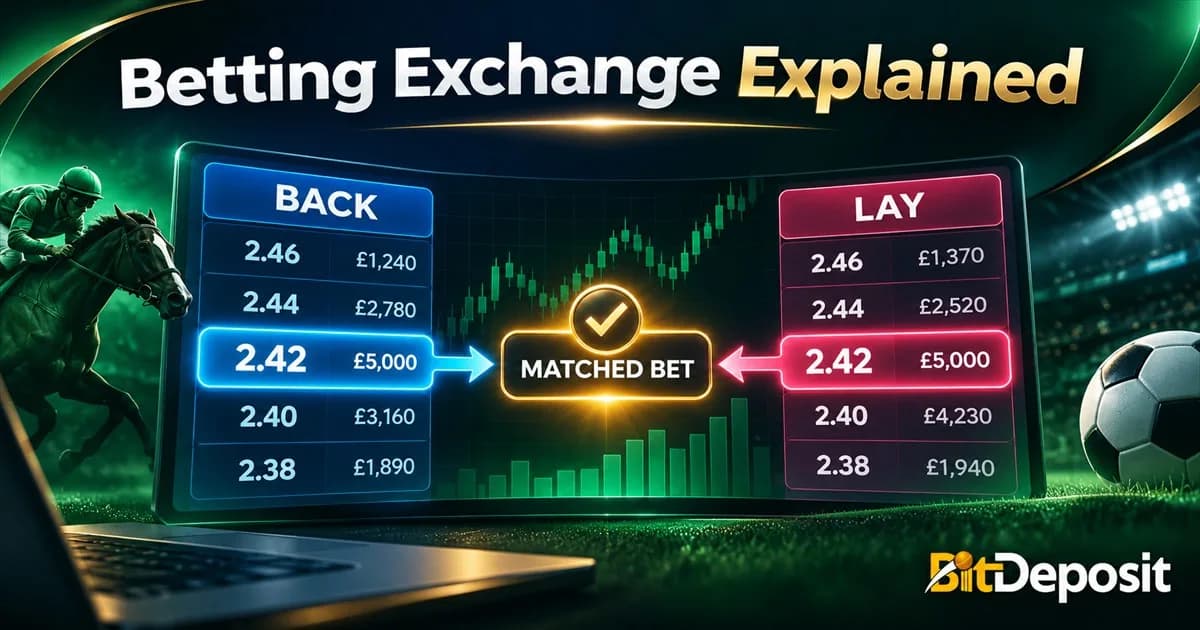
A betting exchange is a marketplace where people bet against each other instead of against a bookmaker. One person backs an outcome to happen, another lays it, meaning they bet that it will not happen, and the exchange matches the two. The exchange earns money by charging a commission on winnings. This guide explains how it works.
Key takeaways
- On a betting exchange, customers set the odds and bet against one another.
- A back bet is a bet that an outcome will happen; a lay bet is a bet that it will not.
- The exchange charges a commission, commonly 2% to 5%, on net winnings.
- A lay bet carries a liability: the amount you pay out if the outcome happens.
- A bet is only placed when another user takes the opposite side.
What is a betting exchange?
A betting exchange is an online platform that matches bets between its users. It does not take a position on the result; it provides the market and settles the bets.
Because the odds come from users competing with each other, there is no bookmaker margin built into the prices. The cost of using an exchange is the commission.
How does a betting exchange work?
A betting exchange works by pairing a backer with a layer at agreed odds. Each market shows two sets of prices: the best odds available to back and the best odds available to lay.
A worked example on a team priced at 3.00:
- You back the team for 100. If it wins, your profit is 200. With a 5% commission, you receive 190 profit. If it does not win, you lose 100.
- You lay the team for 100. You are accepting someone else's 100 stake at 3.00. Your liability is 100 x (3.00 - 1) = 200.
- If the team does not win, you keep the backer's 100, less commission, a profit of 95.
- If the team wins, you pay out 200.
Laying is what a bookmaker does on every bet it accepts.
How does an exchange compare with a bookmaker?
An exchange and a traditional bookmaker, or sportsbook, differ in who sets the odds and how each makes money.
| Feature | Betting exchange | Bookmaker |
|---|---|---|
| Who you bet against | Other users | The bookmaker |
| Who sets the odds | Users | The bookmaker |
| How it earns money | Commission on net winnings | Margin built into the odds |
| Betting against an outcome | Yes, by laying | Not directly |
| Bet acceptance | Only if matched by another user | Normally immediate |
| Odds on popular markets | Often slightly higher | Often slightly lower |
| Odds on minor markets | May be poor or unavailable | Always quoted |
How do you place a bet on an exchange?
To place a bet on an exchange, choose a side, a price and a stake, then wait for the bet to be matched. Follow these steps:
- Open the market and find your selection.
- Choose "back" to bet on it or "lay" to bet against it.
- Take the price shown, or enter the odds you want.
- Enter your stake; for a lay bet, check the liability displayed.
- Submit the bet. It is matched if another user accepts the opposite side.
- Any unmatched part stays in the queue until it is matched, cancelled or the market closes.
Common mistakes to avoid
- Underestimating lay liability. Laying at long odds can cost many times the backer's stake.
- Forgetting the commission. A slightly higher price can be worth less than a bookmaker's price after commission.
- Assuming a bet is on. An unmatched bet has not been placed.
- Trading thin markets. With little money available, prices are poor and bets may not be matched.
- Leaving unmatched bets in play. Check whether an unmatched bet is cancelled or kept when the event starts.
Frequently asked questions
What is a lay bet?
A lay bet is a bet that an outcome will not happen. If you lay a team, you win when it loses or draws and you pay out when it wins. The person laying takes the role of the bookmaker and accepts another user's back bet.
What is liability in a lay bet?
Liability is the amount you stand to lose on a lay bet. It equals the backer's stake multiplied by the odds minus one. Laying 100 at odds of 3.00 gives a liability of 200. The exchange holds this amount from your balance until the bet is settled.
How much commission do betting exchanges charge?
Betting exchanges commonly charge between 2% and 5% commission on net winnings in a market. It is deducted only from winning bets; losing bets pay nothing. A back bet that wins 200 with a 5% commission pays a profit of 190.
Are betting exchange odds better than bookmaker odds?
Betting exchange odds are often slightly higher than bookmaker odds on popular events, because there is no built-in margin. After commission the difference is smaller. On minor events with few users, exchange odds can be worse, or there may be no money available to bet against.
What happens if my exchange bet is not matched?
If your exchange bet is not matched, it has not been placed and your stake is not at risk. An unmatched bet waits in the market until someone accepts it. You can cancel it, change the odds, or let it lapse when the market closes.
Play responsibly
Understanding how an exchange works helps you make informed decisions, but it does not remove the risk of losing, and lay bets can lose more than the stake you accept. Set a budget before you start, never stake money you cannot afford to lose, and take a break if betting stops being enjoyable. Betting is for adults only, and you should check that it is legal where you live. Independent support is available from organisations such as GambleAware.
Summary
- An exchange matches backers with layers and charges commission.
- Back = bet for an outcome; lay = bet against it.
- Lay liability = stake x (odds - 1).
- A bet exists only once another user has matched it.
The margin that exchanges avoid is explained in bookmaker margin explained. Closing a position early is similar to cash out in betting, and other terms are defined in the betting terms glossary. Background is available on Wikipedia.