Volleyball Rules for Beginners: Scoring, Sets and Rotation
A beginner's guide to volleyball rules: rally scoring, sets to 25 points, the three-touch rule, rotation and how indoor and beach volleyball differ.
Bitdeposit · 24 November 2026 · 8 min read
On this page
Volleyball rules for beginners come down to a few points: two teams of six try to ground the ball on the other side of the net, each side has three touches, and every rally scores a point. Matches are the best of five sets. This guide covers scoring, rotation, the libero, common faults and betting markets.
Key takeaways
- Indoor volleyball is played by two teams of six on a court of 18 x 9 m, divided by a net.
- Every rally scores a point for the team that wins it, whichever team served.
- A match is the best of five sets. Sets one to four go to 25 points and the fifth to 15, each won by 2 clear points with no cap.
- Each team has three touches to return the ball, and a block does not count as one of them.
- A team rotates one position clockwise each time it wins the serve back.
What is volleyball?
Volleyball is a team sport in which two teams of six players, separated by a net, score points by landing the ball on the opponent's court or by forcing the opponent into a fault. The international rules are set by the Fédération Internationale de Volleyball (FIVB), the world governing body.
A rally is the sequence of play from the serve until the ball is out of play. A fault is an action that breaks the rules and ends the rally, with the point going to the other team.
How does volleyball scoring and rotation work?
Volleyball scoring works on the rally point system: the team that wins a rally scores one point, whether it served or received. If the receiving team wins the rally, it also takes over the serve.
A set is a part of the match played to a fixed number of points. Sets one to four are won by the first team to reach 25 points with a lead of at least 2. At 24-24 play continues until one team leads by 2, so a set can finish 26-24 or far higher. The fifth set is played to 15 points, again with a 2 point lead. The first team to win three sets wins the match.
A worked example shows the full count. Team A beats Team B 3-2 with set scores of 25-21, 22-25, 25-23, 23-25 and 15-12. Team A scored 25 + 22 + 25 + 23 + 15 = 110 points and Team B scored 21 + 25 + 23 + 25 + 12 = 106 points. The match total is 110 + 106 = 216 points.
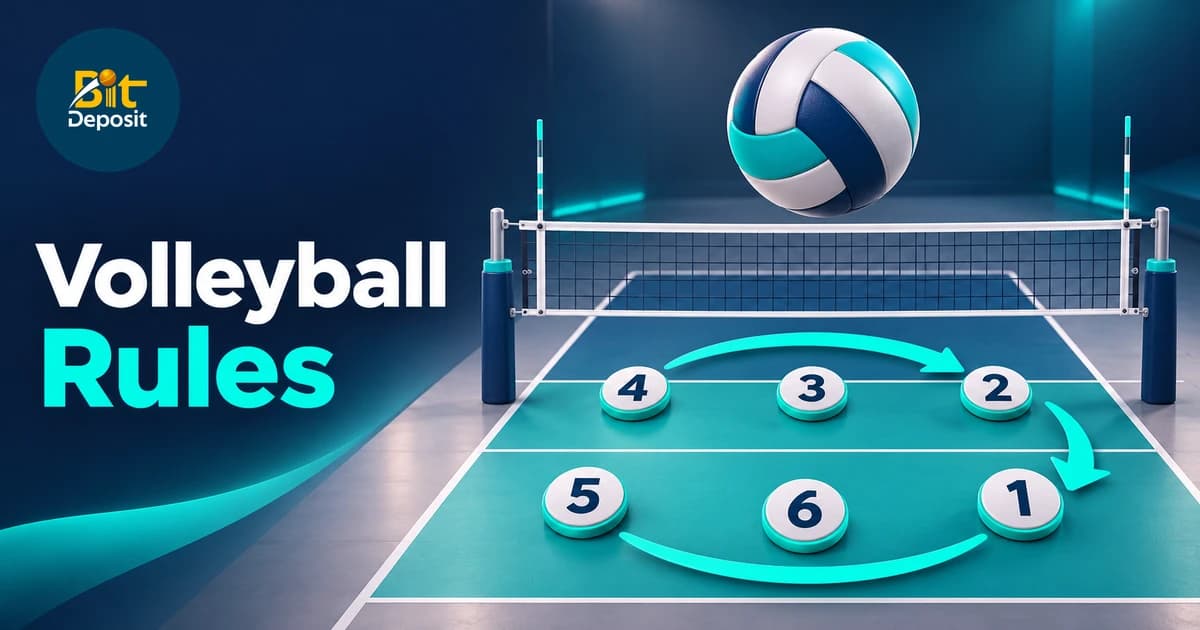
Rotation is the rule that moves all six players one position clockwise each time their team wins the serve back. The player in position 1, back right, serves. After a rotation the player from position 2, front right, moves there to serve. A team that wins a rally on its own serve does not rotate.
The libero is a defensive specialist who wears a different coloured shirt and plays only in the back row. The libero may replace any back-row player without a normal substitution, and may not block or attack the ball above net height. Under FIVB rules the libero does not serve, although some national and college competitions allow it.
How is beach volleyball different from indoor volleyball?
Beach volleyball is different from indoor volleyball in team size, match length and court size: it is played by two players a side over the best of three sets on a smaller sand court. The table compares the two forms under FIVB rules.
| Feature | Indoor volleyball | Beach volleyball |
|---|---|---|
| Players per side | 6 | 2 |
| Match length | Best of five sets | Best of three sets |
| Points per set | 25, with the fifth set to 15 | 21, with the third set to 15 |
| Court size | 18 x 9 m | 16 x 8 m |
| Block | Does not count as a touch | Counts as one of the three touches |
Domestic leagues and school competitions sometimes use shorter formats, so set lengths vary by competition.
How do you follow a volleyball match step by step?
A volleyball match is followed by tracking the serve, the three touches and the score in each set. Follow these steps:
- Check which team is serving, because the server stands behind the end line.
- Count the touches on each side, and remember that a block does not use one of the three.
- Watch where the ball lands. A ball that touches a boundary line is in.
- Note which team wins the rally, because that team scores the point.
- Look for a rotation when the receiving team wins the rally and takes the serve.
- Track the set score to 25, or to 15 in the fifth set, and check for the 2 point lead.
- Count sets won, because the first team to three wins the match.
The main volleyball betting markets are match winner, set handicap and total points. The match winner market has two outcomes only, because a volleyball match cannot end in a draw. A stake of 100 on a team at odds of 1.60 returns 100 x 1.60 = 160 if that team wins.
A set handicap is a market that adds or subtracts sets from a team's result. In the worked example, Team A won 3-2. A bet on Team A -1.5 sets loses, because 3 - 1.5 = 1.5 is less than 2. A stake of 100 on Team B +1.5 sets at odds of 1.80 returns 180, because 2 + 1.5 = 3.5 beats 3.
Total points is an over/under market on all points scored in the match. With a line of 180.5, the example total of 216 settles as over.
Common mistakes to avoid
- Counting the block as a touch. In indoor volleyball a team still has three touches after its block.
- Thinking only the serving team can score. Rally point scoring gives a point to whichever team wins the rally.
- Expecting a set to stop at 25. A set continues until one team leads by 2, so 25-24 is never a final score.
Frequently asked questions
How many points do you need to win a set in volleyball?
A team needs 25 points to win a set in indoor volleyball, with a lead of at least 2 points. The fifth set is played to 15 points with the same 2 point lead. No cap applies, so a set tied at 24-24 continues until one team is 2 points ahead.
How many touches are allowed in volleyball?
Each team is allowed three touches to send the ball back over the net. A block at the net does not count as one of the three in indoor volleyball. One player may not hit the ball twice in a row, except that a blocker may play the first touch after the block.
What does the libero do in volleyball?
The libero is a back-row defensive specialist who mainly receives serves and digs attacks. The libero can replace any back-row player without a normal substitution. The libero may not block or attack the ball above net height, and under FIVB rules does not serve.
What are the most common faults in volleyball?
The most common faults in volleyball are four touches by one team, a double contact by one player, touching the net during play, a foot fault on the serve and hitting the ball out. Each fault ends the rally and gives a point to the other team. Rules on double contact vary slightly by competition.
When do teams rotate in volleyball?
Teams rotate when they win a rally on the opponent's serve and so gain the right to serve. All six players move one position clockwise, and the player arriving at position 1 serves. A team that wins a point on its own serve does not rotate.
Play responsibly
Volleyball betting moves quickly, because points are scored every few seconds and live odds change with each run of serves. Set a budget and a time limit before the match, and never raise the stake to chase a loss. Betting is for adults only and is not legal everywhere, so check the law where you live. Help is available from GambleAware.
Summary
- Indoor volleyball has six players a side, three touches per side and a point on every rally.
- A match is the best of five sets: 25 points in sets one to four and 15 in the fifth, each won by 2 clear points.
- A team rotates clockwise when it wins the serve back, and the libero is a back-row specialist.
The official rules are published by the FIVB. Another net sport with rally scoring is covered in badminton rules for beginners, and a different set system in tennis scoring explained. The markets used here are explained in over/under betting explained and what is Asian handicap.
18+ only. Play for fun, set your limits and take a break when it stops being fun.
Share this post