
Three Card Poker Rules: Hands, Bets and Payouts Explained
Bitdeposit · 18 November 2026 · 7 min read
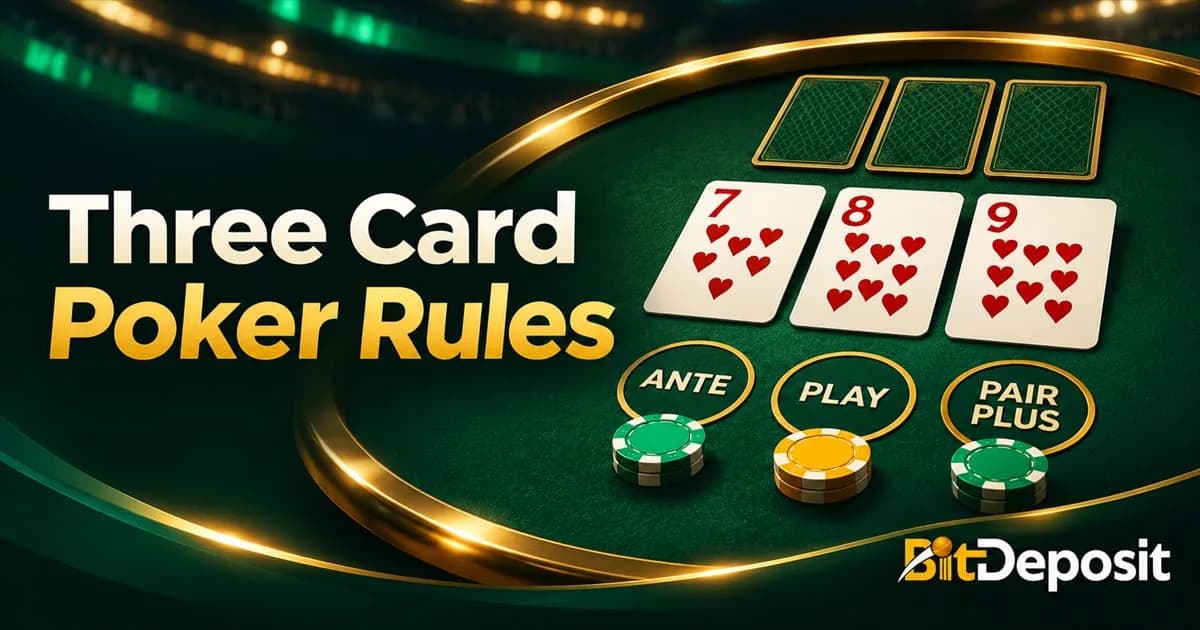
Three Card Poker rules are simple: you and the dealer each receive three cards, and you choose to fold or to play against the dealer's hand. There are two separate bets, Ante/Play and Pair Plus. This guide covers the hand rankings, the dealer's qualifying rule, how bets are settled and the usual payouts.
Key takeaways
- Three Card Poker is played against the dealer, not against other players, with three cards each and no draws.
- The hand ranking is straight flush, three of a kind, straight, flush, pair, high card: a straight beats a flush.
- The dealer needs queen high or better to qualify.
- If the dealer does not qualify, the ante pays 1 to 1 and the play bet is returned.
- Pair Plus is a separate bet that pays when your own hand is a pair or better, whatever the dealer holds.
What is Three Card Poker?
Three Card Poker is a casino table game in which each player competes against the dealer using a three-card poker hand. It uses one standard 52-card deck.
Ante/Play is a contest between your hand and the dealer's hand. Pair Plus is a bet on the strength of your own three cards.
Three Card Poker rules: how does a round work?
A round of Three Card Poker works in five steps, from the first bet to the settlement.
- Place your bets. Put a stake on Ante, on Pair Plus, or on both.
- Receive three cards. You and the dealer each receive three cards, with the dealer's cards face down.
- Fold or play. If you fold, you lose the ante. If you play, you place a Play bet equal to the ante.
- The dealer reveals. The dealer's hand qualifies if it is queen high or better.
- Bets are settled. The Ante and Play bets are settled against the dealer's hand, and Pair Plus is settled on your hand alone.
| Situation | Ante bet | Play bet |
|---|---|---|
| You fold | Lost | Not placed |
| Dealer does not qualify | Pays 1 to 1 | Returned (push) |
| Dealer qualifies and you have the higher hand | Pays 1 to 1 | Pays 1 to 1 |
| Dealer qualifies and has the higher hand | Lost | Lost |
| Dealer qualifies and the hands tie | Returned (push) | Returned (push) |
A worked example with 100 on Ante and 100 on Pair Plus. You hold a pair of nines and place a Play bet of 100. The dealer shows king, seven, four, which qualifies but loses to a pair. The ante wins 100, the play bet wins 100 and Pair Plus wins 100 at 1 to 1, a total profit of 300.
How do Three Card Poker hands rank?
Three Card Poker hands rank in a different order from five-card poker, because the chances change with only three cards. There are 22,100 possible three-card hands, and a straight is rarer than a flush, so the straight ranks higher.
| Hand, highest first | Possible hands | Probability |
|---|---|---|
| Straight flush | 48 | 0.22% |
| Three of a kind | 52 | 0.24% |
| Straight | 720 | 3.26% |
| Flush | 1,096 | 4.96% |
| Pair | 3,744 | 16.94% |
| High card | 16,440 | 74.39% |
An ace can be high or low in a straight, so ace, 2, 3 is the lowest straight and queen, king, ace is the highest. Hands of the same rank are compared card by card, starting with the highest card.
What are the payouts in Three Card Poker?
The payouts in Three Card Poker are 1 to 1 on winning Ante and Play bets, plus fixed paytables for the ante bonus and for Pair Plus. Paytables vary by casino, so the figures below are common examples, not universal rules.
The ante bonus is paid on the ante when you hold a straight or better, usually even if the dealer's hand is stronger.
| Your hand | Common ante bonus | Common Pair Plus payout |
|---|---|---|
| Straight flush | 5 to 1 | 40 to 1 |
| Three of a kind | 4 to 1 | 30 to 1 |
| Straight | 1 to 1 | 6 to 1 |
| Flush | None | 4 to 1 or 3 to 1 |
| Pair | None | 1 to 1 |
| High card | None | Loses |
With these payouts the house edge on Pair Plus is about 2.3% when a flush pays 4 to 1 and about 7.3% when it pays 3 to 1.
When should you play or fold?
The commonly cited guideline is to play queen, six, four or better and to fold anything lower. The guideline keeps the house edge on the Ante/Play bet near its minimum. It is not a way to win, and the edge remains with the house.
Common mistakes to avoid
- Using five-card rankings. In Three Card Poker a straight beats a flush.
- Assuming every table pays the same. Paytables differ, and a flush paying 3 to 1 on Pair Plus raises the house edge noticeably.
- Treating Pair Plus as part of the main game. Pair Plus ignores the dealer's hand completely and loses about three times in four.
Frequently asked questions
Does a straight beat a flush in Three Card Poker?
Yes, a straight beats a flush in Three Card Poker. With three cards there are 720 possible straights and 1,096 possible flushes, so the straight is the rarer hand and ranks higher. The order is the reverse of five-card poker, where a flush is harder to make than a straight.
What does the dealer need to qualify in Three Card Poker?
The dealer needs a hand of queen high or better to qualify in Three Card Poker. A hand such as queen, seven, two qualifies, and jack, nine, five does not. When the dealer fails to qualify, players who made a play bet are paid 1 to 1 on the ante and the play bet is returned.
What is the Pair Plus bet?
The Pair Plus bet is a separate wager that your three cards will contain a pair or better. It is settled on your hand alone, so the dealer's cards do not matter. A common paytable pays 1 to 1 for a pair and up to 40 to 1 for a straight flush, although payouts vary by casino.
What is the ante bonus in Three Card Poker?
The ante bonus is an extra payout on the ante bet for a straight, three of a kind or straight flush. A common paytable pays 1 to 1 for a straight, 4 to 1 for three of a kind and 5 to 1 for a straight flush. It is usually paid even if the dealer wins the hand.
When should you fold in Three Card Poker?
The commonly cited guideline is to fold any hand lower than queen, six, four and to play that hand or better. The guideline comes from analysis of the Ante/Play bet and keeps the house edge close to its minimum. It does not guarantee a winning result in any hand or session.
Play responsibly
Three Card Poker moves quickly, and the house keeps an edge on both the Ante/Play and Pair Plus bets. Fix the amount you are prepared to spend before you sit down, and pause between sessions. The game is for adults only, and gambling laws differ by country, so confirm what applies where you live. Advice and support are available from GambleAware.
Summary
- Three Card Poker is played against the dealer with three cards each and one decision: fold or play.
- The ranking is straight flush, three of a kind, straight, flush, pair, high card.
- The dealer qualifies with queen high or better.
- Ante bonus and Pair Plus paytables vary by casino, so check them before playing.
For the five-card version of poker played against other players, see Texas Hold'em rules for beginners. A related three-card game is covered in Teen Patti rules. The percentages quoted for each bet are explained in house edge explained.