
T20 vs ODI vs Test Cricket: Key Differences Explained
Bitdeposit · 15 November 2026 · 7 min read
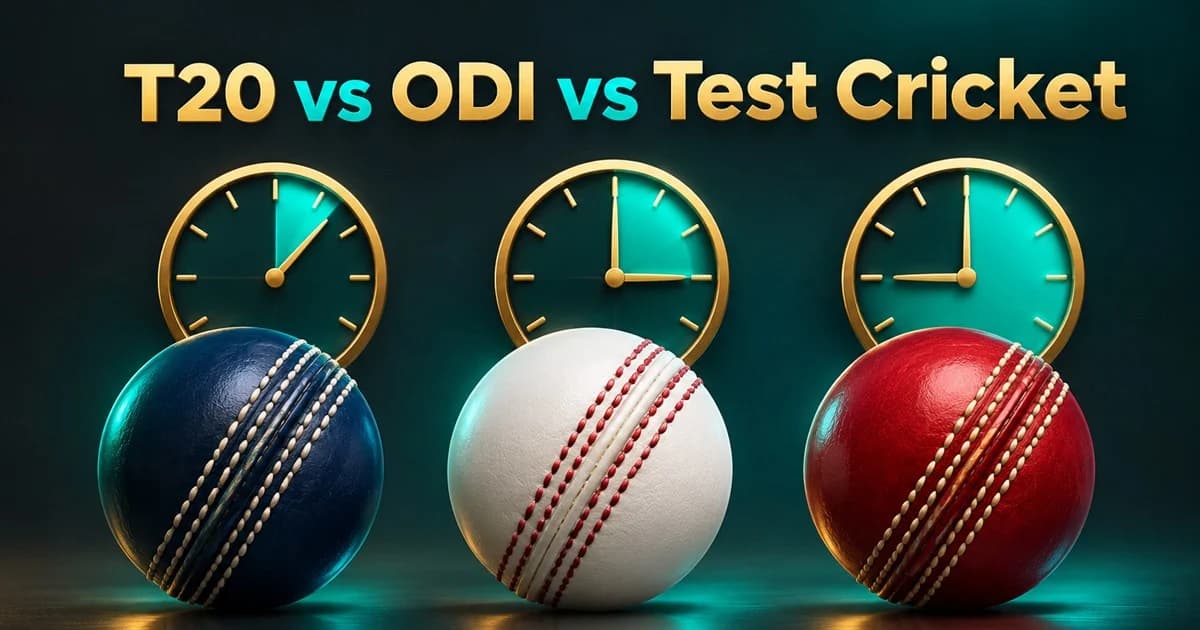
T20, ODI and Test are the three international formats of cricket, and they differ mainly in length. A T20 match gives each team 20 overs and lasts about three hours. An ODI gives each team 50 overs and lasts a full day. A Test match is played over up to five days with two innings per team.
Key takeaways
- T20 cricket has 20 overs per side; ODI cricket has 50 overs per side.
- Test cricket has no over limit per innings and lasts up to five days.
- Only Test matches can end in a draw.
- A bowler may bowl at most 4 overs in a T20 and 10 overs in an ODI.
- A tied T20 match is normally decided by a Super Over.
What are the three formats of cricket?
The three formats of international cricket are Test cricket, One Day Internationals (ODIs) and Twenty20 Internationals (T20Is). All three are governed by the International Cricket Council (ICC) and use the same basic laws.
Test cricket is the oldest format and dates from 1877. One-day cricket began at international level in 1971, and T20 internationals followed in 2005. ODIs and T20s are together called limited-overs or white-ball cricket.
How do the formats work?
Each format works by limiting the match in a different way: Tests by time, and ODIs and T20s by overs. An over is six legal deliveries bowled by one bowler.
- Test: each team bats twice. A team's innings ends when ten batters are out or the captain declares.
- ODI: each team bats once for a maximum of 50 overs.
- T20: each team bats once for a maximum of 20 overs.
In limited-overs cricket the team with more runs wins. In a Test, a team must also bowl the opposition out twice; if time runs out first, the match is a draw.
How do T20, ODI and Test cricket compare?
The table sets out the main differences between the three formats.
| Feature | T20 | ODI | Test |
|---|---|---|---|
| Overs per innings | 20 | 50 | No limit |
| Innings per team | 1 | 1 | 2 |
| Typical duration | About 3 hours | About 8 hours | Up to 5 days |
| Maximum overs per bowler | 4 | 10 | No limit |
| Ball | White | White | Red (pink in day-night matches) |
| Clothing | Coloured | Coloured | White |
| Draw possible | No | No | Yes |
| Tie-break | Super Over | Super Over in knockout matches | None |
| Powerplay | Overs 1 to 6 | Three phases across 50 overs | None |
T20 cricket
T20 is the shortest format and favours aggressive batting. During the powerplay, the first six overs, only two fielders may stand outside the 30-yard circle. After that, up to five are allowed.
ODI cricket
An ODI innings has three powerplay phases. In overs 1 to 10, two fielders are allowed outside the circle; in overs 11 to 40, four are allowed; and in overs 41 to 50, five are allowed.
Test cricket
A Test match is scheduled for five days with a minimum of 90 overs a day. A new ball is available after 80 overs. A team that leads by 200 runs or more after the first innings may ask the opposition to bat again, which is called enforcing the follow-on.
How do you tell which format you are watching?
To tell which format you are watching, check a few visible features. Follow these steps:
- Look at the clothing: white means Test cricket, coloured means limited overs.
- Look at the ball: red or pink means Test cricket, white means limited overs.
- Check the scoreboard for an over count out of 20 or 50.
- Check whether the scoreboard shows a first and second innings for each team.
- Note the match length: a single evening is T20, a full day is an ODI, and several days is a Test.
How does the format affect betting markets?
The format changes which outcomes are possible and how quickly a match can turn.
- Results: Test matches include the draw, so the match market has three outcomes.
- Totals: a competitive T20 total is often 160 to 200 runs, while ODI totals are often 250 to 350.
- Volatility: in T20 a single over can change the match, so live odds move sharply.
- Weather: rain is more likely to force a draw in a Test and a reduced-overs match in the shorter formats.
Common mistakes to avoid
- Comparing scores across formats. A run rate of 6 an over is slow in T20 and quick in a Test.
- Forgetting the draw. Leading a Test match on runs is not the same as winning it.
- Assuming a tie means a shared result. Most T20 matches use a Super Over to find a winner.
- Ignoring bowling limits. A team's best bowler can deliver only a fifth of the overs in limited-overs cricket.
- Overlooking conditions. Pitch and weather matter more over five days than over three hours.
Frequently asked questions
How long does a T20 match last?
A T20 match lasts about three hours. Each innings of 20 overs takes roughly 75 to 90 minutes, with a short interval between them. That makes T20 the only international format that is completed in a single evening, which is a major reason for its popularity.
How many overs are there in an ODI?
There are 50 overs per side in an ODI, giving a maximum of 100 overs in the match. Each bowler may deliver no more than 10 overs, so a team needs at least five bowlers. A full ODI takes about eight hours, including the interval between innings.
Why can a Test match end in a draw?
A Test match can end in a draw because it is limited by time, not by overs. To win, a team must score more runs and dismiss the opposition twice. If the fifth day ends before that happens, neither side wins, whatever the scores are.
What is a Super Over?
A Super Over is a tie-break used in limited-overs cricket when the scores are level. Each team faces one extra over of six balls, and the team that scores more runs wins. It is standard in T20 matches and is used in ODI knockout matches.
Which cricket format is the most popular?
T20 is the most widely watched format because matches are short and high-scoring, and it is the basis of franchise leagues such as the Indian Premier League (IPL). Test cricket is regarded as the most demanding format, and ODIs are best known for the Cricket World Cup.
Play responsibly
Understanding the formats helps you follow the game and make informed decisions, but it does not remove the risk of losing if you bet on it. Set a budget before you start, never stake money you cannot afford to lose, and take a break if betting stops being enjoyable. Betting is for adults only, and you should check that it is legal where you live. Independent support is available from organisations such as GambleAware.
Summary
- T20: 20 overs a side, about three hours.
- ODI: 50 overs a side, a full day.
- Test: two innings each, up to five days, and the only format with a draw.
- Shorter formats are more volatile; longer formats are more affected by conditions.
For the markets offered on each format, read cricket betting markets explained and the guide to cricket formats, markets and rules. In-match price changes are covered in live betting explained. Official playing conditions are published by the International Cricket Council.