
Pot Odds Explained: How to Calculate Pot Odds in Poker
Bitdeposit · 23 November 2026 · 8 min read
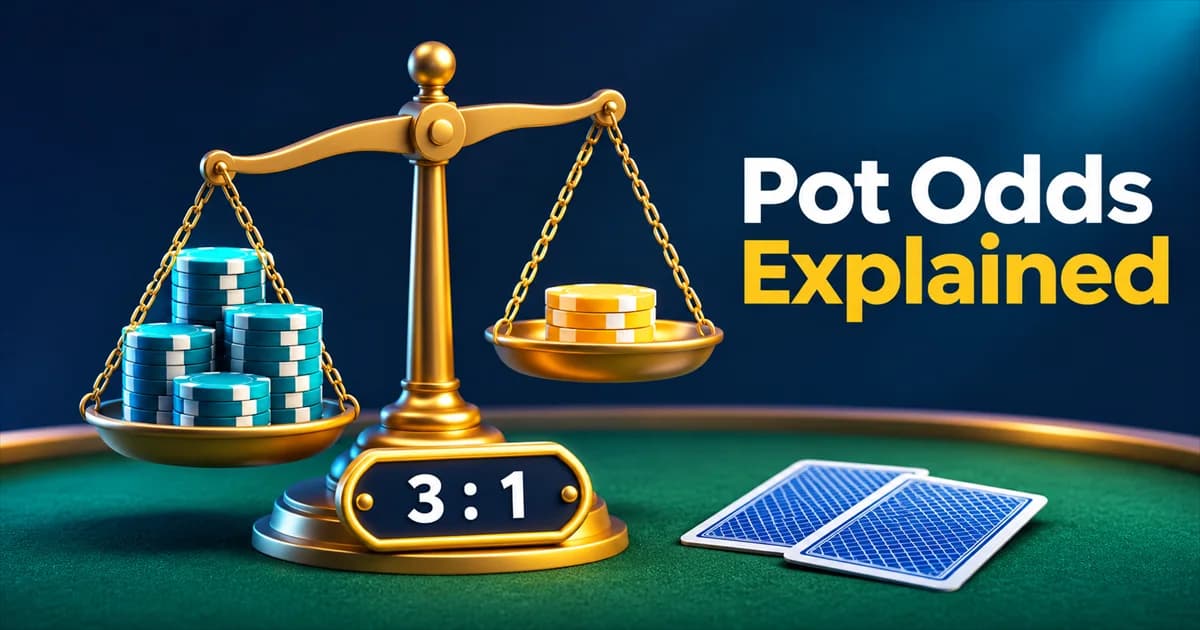
Pot odds explained simply: pot odds are the ratio between the money in a poker pot, including the opponent's bet, and the cost of a call. A pot of 150 with 50 to call gives pot odds of 3 to 1, so the call needs 25% equity to break even. This guide covers the formula, outs and implied odds.
Key takeaways
- Pot odds compare the size of the pot, including the bet being faced, with the cost of calling.
- The break-even equity is the call divided by the pot after the call: 50 / (150 + 50) = 25%.
- A flush draw has 9 outs, which hit 19.57% of the time with one card to come and 34.97% with two cards to come.
- Pot odds guide a decision but do not remove risk.
What are pot odds?
Pot odds are a ratio in poker that compares the current size of the pot with the cost of calling a bet. The pot includes every chip already in the middle plus the bet the opponent has just made.
The chance of winning the pot is called equity and is written as a percentage. A call makes money on average only when the hand's equity is higher than the break-even figure given by the pot odds. The examples in this guide use Texas Hold'em, in which each player has 2 private cards and shares 5 community cards.
How do pot odds work?
Pot odds work by dividing the pot by the cost of the call and then turning that ratio into a break-even percentage. A worked example with real numbers:
- The pot holds 100 before the opponent acts.
- The opponent bets 50, so the pot is now 100 + 50 = 150.
- The call costs 50, so the pot odds are 150 to 50, which simplifies to 3 to 1.
- The break-even equity is the call divided by the final pot: 50 / (150 + 50) = 50 / 200 = 25%.
A call at 3 to 1 needs to win more than 25% of the time to show a profit in the long run.
The other half of the sum is the chance of improving, which is counted in outs. An out is an unseen card that completes the hand. A flush draw (four cards of one suit, needing a fifth) has 13 - 4 = 9 outs. After the turn (the fourth community card), 6 cards are known and 52 - 6 = 46 are unseen. The chance of hitting on the river (the fifth and last community card) is 9 / 46 = 19.57%.
That 19.57% is below the 25% needed, so this call loses money on average.
What are the odds of hitting common poker draws?
The odds of hitting a draw depend on the number of outs and on whether one or two cards are still to come. The table shows exact figures for four common draws in Texas Hold'em.
| Draw | Outs | River only (46 unseen) | Turn and river (47 unseen) |
|---|---|---|---|
| Flush draw | 9 | 19.57% | 34.97% |
| Open-ended straight draw | 8 | 17.39% | 31.45% |
| Two overcards | 6 | 13.04% | 24.14% |
| Gutshot straight draw | 4 | 8.70% | 16.47% |
The two-card figure is found by working out the chance of missing twice. After the flop (the first three community cards), 47 cards are unseen. A flush draw misses the turn 38 times in 47 and then misses the river 37 times in 46. The chance of hitting at least once is 1 - (38/47 x 37/46) = 1 - 0.6503 = 34.97%.
The rule of 2 and 4 is a shortcut for the same sums. Multiply the outs by 2 with one card to come, and by 4 on the flop with two cards to come. For a flush draw that gives 9 x 2 = 18% and 9 x 4 = 36%, close to the exact 19.57% and 34.97%.
The two-card figure only applies when no further bet has to be called on the turn. Outs are also estimates: two overcards (private cards higher than any card on the board) have 6 outs to make a pair, which is not always the best hand.
What is the difference between pot odds and implied odds?
Pot odds count only the money in the pot now, while implied odds also count the money a player expects to win on later betting rounds if the draw completes.
Take a flush draw facing a bet of 50 that makes the pot 150, with one card to come. The draw wins 9 times in 46, so the break-even final pot is 50 x 46 / 9 = 255.56. The pot after the call is only 200, so the caller must expect to win about 56 more on the river when the flush arrives.
Pot odds are exact, while implied odds are an estimate. An opponent may fold when the third suited card arrives, and then the extra money never comes.
How do you use pot odds at the table?
Pot odds are used at the table by comparing the price of a call with the chance of making the hand. Follow these steps:
- Count the pot, including the bet you are facing.
- Work out the cost of the call.
- Divide the call by the pot plus the call to find the break-even equity.
- Count your outs, leaving out any card that could give an opponent a better hand.
- Estimate your chance with the rule of 2 and 4.
- Fold when your chance is clearly lower than the break-even figure.
Common mistakes to avoid
- Leaving the opponent's bet out of the pot. The bet faced is part of the pot, so a pot of 100 and a bet of 50 offer 150 to 50, not 100 to 50.
- Using the two-card percentage with a bet still to come. The 34.97% figure for a flush draw assumes both cards are seen for the price of one call.
- Counting outs that do not win. A card that completes a straight may also complete an opponent's flush.
Frequently asked questions
How do you calculate pot odds?
Pot odds are calculated by dividing the pot, including the opponent's bet, by the cost of the call. A pot of 150 and a call of 50 gives 3 to 1. The break-even percentage is the call divided by the pot plus the call: 50 / 200 = 25%.
What are good pot odds in poker?
Good pot odds are odds that ask for less equity than the hand actually has. A flush draw with one card to come has 19.57% equity, so it needs pot odds better than about 4.1 to 1. No fixed ratio is good in every hand.
What is the rule of 2 and 4?
The rule of 2 and 4 is a shortcut for estimating the chance of completing a draw. Multiply the number of outs by 2 with one card to come, or by 4 with two cards to come. Eight outs give roughly 16% and 32%, against exact figures of 17.39% and 31.45%.
Are pot odds the same as equity?
No, pot odds and equity are different numbers that are compared with each other. Pot odds describe the price offered by the pot, and equity is the share of the pot a hand expects to win. A call is profitable on average only when equity is higher than the break-even percentage.
Do pot odds guarantee a profit?
No, pot odds do not guarantee a profit. A call with correct odds still loses whenever the draw misses, and a flush draw misses the river more than 80% of the time. Pot odds describe only the average result over a very large number of hands.
Play responsibly
Poker combines skill and chance, and pot odds do not remove the risk of losing money. Set a budget before you sit down, and stop when it is gone. Poker for money is for adults only and is not legal everywhere, so check the law where you live. Help is available from GambleAware.
Summary
- Pot odds are the ratio of the pot, including the bet faced, to the cost of a call.
- Break-even equity is the call divided by the pot after the call: 50 / 200 = 25% at pot odds of 3 to 1.
- A flush draw has 9 outs and hits 19.57% of the time with one card to come and 34.97% with two.
The betting rounds used in these examples are set out in Texas Hold'em rules for beginners, and the hands a draw is trying to make are ranked in poker hand rankings for beginners. Odds are turned into percentages in implied probability explained.