Poker Positions Explained: Button, Blinds and Early Seats
A beginner's guide to poker positions: the blinds, early, middle and late seats, the order of action in each betting round and why the button acts last.
Bitdeposit · 24 November 2026 · 8 min read
On this page
Poker positions explained in one sentence: a position is the seat a player holds relative to the dealer button, and it decides when that player acts in each betting round. Players who act later see more of their opponents' decisions first. This guide covers the seat names, the order of action and how position affects starting hands.
Key takeaways
- Position in poker is where a player sits relative to the dealer button, and it sets the order of action.
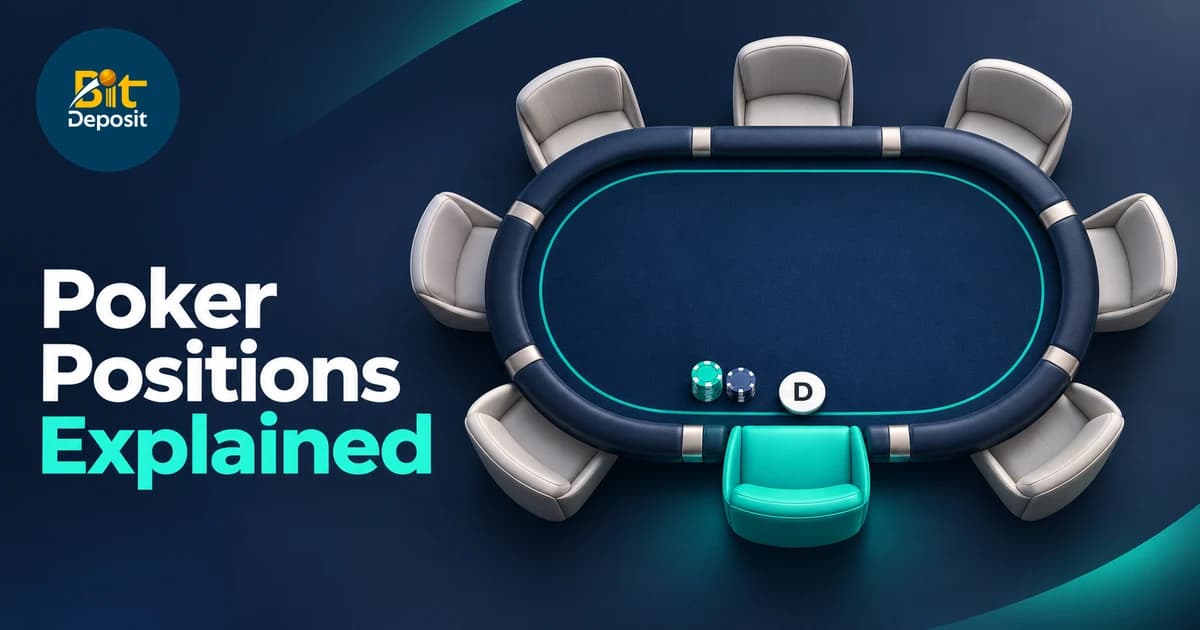
- A 9-handed table has nine named seats: small blind, big blind, under the gun, UTG+1, UTG+2, lojack, hijack, cutoff and button.
- The button acts last in every betting round after the flop, which gives the most information.
- The blinds act last before the flop and first in every round after it.
What are poker positions?
Poker positions are the named seats at a poker table, defined by how far each seat is from the dealer button. The dealer button is a round marker that shows which player is the nominal dealer for the hand. Position matters in games with a button and blinds, such as Texas Hold'em and Omaha.
The blinds are forced stakes placed before the cards are dealt by the two players to the left of the button. The small blind is the first seat to the left of the button, and the big blind is the next seat. Action moves clockwise around the table.
How do poker positions work?
Poker positions work by fixing the order in which players act in each betting round. Before the flop, the first player to act is the seat to the left of the big blind, and the big blind acts last. The flop is the first three community cards, which are dealt face up for all players to use.
After the flop, the order changes. The small blind acts first, or the first player still in the hand to the left of the button, and the button acts last. The same order applies on the turn and the river, which are the fourth and fifth community cards.
A worked example shows the difference. At a 9-handed table, the player under the gun acts first before the flop, with 8 players still to act behind. The button has only 2 players behind, the two blinds, and will act last in every later round.
The blinds also carry a cost. With blinds of 50 and 100, one orbit of a 9-handed table costs each player 50 + 100 = 150. An orbit is one full circuit of the button around the table. Over 90 hands, which is 10 orbits, the blinds cost 10 x 150 = 1,500.
What are the positions at a 9-handed poker table?
The positions at a 9-handed poker table are the small blind, big blind, under the gun, UTG+1, UTG+2, lojack, hijack, cutoff and button. The table lists them clockwise from the button with their usual group and their order of action.
| Position | Group | Acts before the flop | Acts after the flop |
|---|---|---|---|
| Small blind (SB) | Blinds | 8th | 1st |
| Big blind (BB) | Blinds | 9th, last | 2nd |
| Under the gun (UTG) | Early | 1st | 3rd |
| UTG+1 | Early | 2nd | 4th |
| UTG+2 | Early | 3rd | 5th |
| Lojack (LJ) | Middle | 4th | 6th |
| Hijack (HJ) | Middle | 5th | 7th |
| Cutoff (CO) | Late | 6th | 8th |
| Button (BTN) | Late | 7th | 9th, last |
Under the gun is the seat directly to the left of the big blind, which must act first before the flop. The cutoff is the seat directly to the right of the button, and the hijack and lojack are the next two seats to its right.
The groups are a convention, not an official rule. Some players count UTG+2 as a middle position, and seat names vary between poker rooms.
A 6-max table has six seats: small blind, big blind, under the gun, hijack, cutoff and button. The early seats of a full table do not exist, so each player pays blinds more often: two hands in every six.
Why is acting last an advantage in poker?
Acting last is an advantage in poker because the last player sees what every opponent does before making a decision.
The player who acts first must decide with the least information. A bet from early position can be raised by anyone behind, and a check may be followed by a bet. This is why the blinds are hard seats to play: they act last before the flop only, and first in every round after it.
Position is an advantage, not a guarantee. The cards still decide most showdowns, and a poker room usually takes a rake, which is a small fee taken from each pot.
How do you use position at the poker table step by step?
Position is used by finding the button, counting the players still to act and adjusting the range of starting hands to the seat. A starting hand is the set of private cards a player is dealt before the flop. Follow these steps:
- Find the dealer button before each hand, because every position is counted from it.
- Count the seats between your seat and the button to name your position.
- Count how many players will act after you before the flop.
- Play fewer starting hands from early position, where many players are still to act.
- Widen the range of starting hands in late position, especially when everyone before you has folded.
- Follow the button as it moves one seat clockwise after every hand.
These points are general. The right starting hands also depend on the game, the stack sizes, the number of players and the action so far.
Common mistakes to avoid
- Playing the same hands from every seat. A hand that is reasonable on the button can be a losing hand under the gun, because more players are still to act.
- Thinking the blinds are good positions because they act last before the flop. The blinds act first on the flop, turn and river.
- Treating position as a way to win every pot. Position improves decisions over many hands, and single hands still depend on the cards.
Frequently asked questions
What is the best position in poker?
The button is the best position in poker. The player on the button acts last in every betting round after the flop and so sees every opponent's action first. Before the flop, only the two blinds act after the button.
What does under the gun mean in poker?
Under the gun, shortened to UTG, is the seat directly to the left of the big blind. The player in this seat acts first before the flop, with every other player still to act. At a 9-handed table that means 8 players behind.
Who acts first after the flop in poker?
The small blind acts first after the flop if that player is still in the hand. If the small blind has folded, the first active player to the left of the button acts first. The button acts last. The same order applies on the turn and the river.
What are the positions at a 6-max poker table?
The positions at a 6-max table are small blind, big blind, under the gun, hijack, cutoff and button. Under the gun acts first before the flop, and the button acts last after it. With only six seats, each player posts a blind in two of every six hands.
How does the dealer button move in poker?
The dealer button moves one seat clockwise after every hand. The blinds move with it, so the player who was the big blind becomes the small blind, and the small blind becomes the button. Over one orbit of a 9-handed table, each player holds each of the nine positions once.
Play responsibly
Poker is played against other players for real money, and position does not remove the risk of losing a stake. Set a budget and a time limit before you sit down, and never move to higher stakes to chase losses. Gambling is for adults only and is not legal everywhere, so check the law where you live. Help is available from GambleAware.
Summary
- A poker position is a seat defined by its distance from the dealer button, and it sets the order of action.
- Acting last gives more information, so fewer hands are played from early position and more from late position.
- The button moves one seat clockwise each hand, and the blinds act last before the flop and first after it.
The betting rounds are covered in Texas Hold'em rules for beginners, and the four-card version of the game in Omaha poker rules. The maths of calling a bet is explained in pot odds explained.
18+ only. Play for fun, set your limits and take a break when it stops being fun.
Share this post