Gambler's Fallacy Explained: Why Past Results Do Not Count
A beginner's guide to the gambler's fallacy: why a run of reds does not make black more likely, how the probabilities work and how to avoid the mistake.
Bitdeposit · 23 November 2026 · 8 min read
On this page
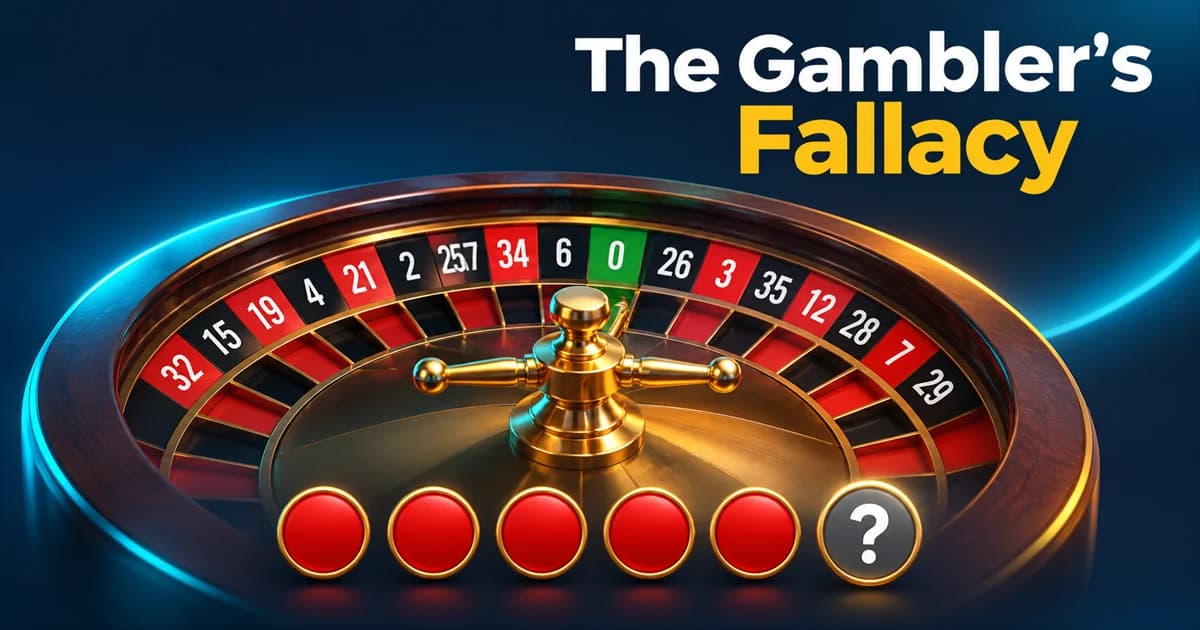
The gambler's fallacy is the mistaken belief that past results of independent events change the chance of the next one, for example that black is "due" after a run of reds. Each roulette spin, coin toss or slot spin has the same odds as the last. This guide covers the maths, examples and ways to avoid it.
Key takeaways
- The gambler's fallacy is the belief that a result is due because it has not happened for a while.
- On a European roulette wheel the chance of red is 18/37 = 48.65% on every spin, whatever came before.
- Five reds in a row has a chance of about 2.72% before the run starts, but after four reds the chance of a fifth is still 48.65%.
- At the Monte Carlo Casino on 18 August 1913, black came up 26 times in a row and players lost heavily betting on red.
What is the gambler's fallacy?
The gambler's fallacy is a reasoning error in which a person believes that past results of a random, independent event make a particular future result more or less likely. Independent means that one result has no effect on the next. A roulette wheel, a coin and a pair of dice have no memory.
The fallacy is also called the Monte Carlo fallacy, after a famous night at the Monte Carlo Casino. On 18 August 1913, black came up 26 times in a row at a roulette table. Players bet larger and larger sums on red, convinced that the run had to end, and lost heavily as it continued.
How does the gambler's fallacy work?
The gambler's fallacy works by confusing the chance of a whole streak with the chance of the next single result. A long streak is unlikely before it starts. Once most of it has happened, only the next spin is uncertain.
A European roulette wheel has 37 pockets: 18 red, 18 black and 1 green zero. The chance of red on any spin is 18 / 37 = 0.4865, or 48.65%. The chance of five reds in a row, worked out before the first spin, is 0.4865 x 0.4865 x 0.4865 x 0.4865 x 0.4865 = 0.0272, or about 2.72%.
| Reds in a row | Chance before the run starts | Chance that the next spin is red |
|---|---|---|
| 1 | 48.65% | 48.65% |
| 2 | 23.67% | 48.65% |
| 3 | 11.51% | 48.65% |
| 4 | 5.60% | 48.65% |
| 5 | 2.72% | 48.65% |
Suppose four reds have already come up. The fallacy says that a fifth red is very unlikely, so black must be due. The four reds are no longer uncertain, so the chance of a fifth red is simply 18 / 37 = 48.65%. The figure of 2.72% is the 5.60% chance of four reds multiplied by the 48.65% chance of one more: 0.0560 x 0.4865 = 0.0272.
The mistake costs money when it changes the stake. A player who sees four reds and bets on black with stakes of 10, 20, 40 and 80 loses 10 + 20 + 40 + 80 = 150 if none of them wins.
How is the gambler's fallacy different from the hot hand and from dependent events?
The gambler's fallacy expects a streak to end, the hot-hand belief expects a streak to continue, and dependent events are cases where earlier results really do change later chances. The table compares the three ideas.
| Idea | What the person believes | Example | Is the belief correct? |
|---|---|---|---|
| Gambler's fallacy | A streak must end, so the opposite result is due | Black is due after five reds | No, for independent events |
| Hot-hand belief | A streak will carry on | A slot is "hot" after two wins in a row | No, for random games |
| Dependent events | Earlier results change later chances | Cards dealt from one deck without replacement | Yes, the chances change |
Cards show what real dependence looks like. A single deck has 52 cards and 4 aces, so the chance that the first card is an ace is 4 / 52 = 7.69%. If an ace is dealt and not returned, the chance that the next card is an ace falls to 3 / 51 = 5.88%. If the first card is not an ace, the chance rises to 4 / 51 = 7.84%.
The test is whether anything physical links one result to the next. Online, a random number generator (RNG) produces each slot spin or digital roulette result separately, so a slot is never "due" to pay.
How do you avoid the gambler's fallacy?
The gambler's fallacy is avoided by checking whether events are independent and by fixing stakes and limits before play starts. Follow these steps:
- Ask whether one result can physically affect the next, and treat spins, tosses and RNG results as independent.
- Ignore the board of recent results beside a roulette table, because it has no predictive value.
- Set the stake before you start and keep it the same after a loss.
- Fix a loss limit and a time limit, and stop when either is reached.
- Treat the thought "a win is due" as a signal to take a break.
Every bet on a European wheel has a house edge of 1 / 37 = 2.70%, so 10 bets of 100 on red carry an expected loss of 1,000 x 2.70% = 27, whatever the previous spins were.
Common mistakes to avoid
- Raising the stake because a result is due. The chance has not changed, so the larger stake only increases the amount at risk.
- Believing a slot is ready to pay. Each spin is produced separately by an RNG, and a long losing run does not bring a win closer.
- Applying the fallacy in reverse. Backing a "hot" number or colour is the same error, because the game is still random.
Frequently asked questions
What is the gambler's fallacy in simple terms?
The gambler's fallacy is the false idea that a random result is due because it has not happened recently. A fair coin that lands heads five times is still 50% to land heads on the sixth toss. The coin has no memory, so earlier tosses cannot push the next one towards tails.
Why is it called the Monte Carlo fallacy?
It is called the Monte Carlo fallacy because of a roulette game at the Monte Carlo Casino on 18 August 1913, when black came up 26 times in a row. Players kept betting on red in the belief that the streak had to end, and they lost large sums.
What is the difference between the gambler's fallacy and the hot hand?
The gambler's fallacy expects a streak to reverse, while the hot-hand belief expects it to continue. Both are wrong for random games such as roulette and slots, where each result is independent. In sports, form can reflect real skill, but it is hard to separate from chance and is usually reflected in the odds.
Does the gambler's fallacy apply to slots?
Yes, the gambler's fallacy applies to slots. An online slot uses a random number generator to produce each spin separately, so a machine that has not paid for a long time is not due a win. A machine that has just paid a jackpot is also no less likely to pay on the next spin.
Does the gambler's fallacy apply to card games?
It applies only where the cards are reshuffled between rounds. In a game dealt from a shoe without replacement, the cards already dealt do change what can come next, so the events are dependent. Many online card games shuffle before every hand, which makes each hand independent again.
Play responsibly
The feeling that a win is due is one of the most common reasons people chase losses. Set a budget and a time limit before you play, and stop when you reach either. Gambling is for adults only and is not legal everywhere, so check your local law. Help is available from GambleAware, and limit options are described in responsible gambling tools.
Summary
- The gambler's fallacy is the belief that past independent results change the chance of the next one.
- Red on a European wheel is 48.65% on every spin, including the spin after four or five reds.
- Dependent events, such as cards dealt without replacement, are the exception because the chances really change.
The bets used in the examples are set out in roulette rules for beginners, and the 2.70% figure is explained in house edge explained. The way online games produce independent results is covered in what is a random number generator. A staking plan built on the idea that a win is due is examined in Martingale betting system explained.
18+ only. Play for fun, set your limits and take a break when it stops being fun.
Share this post