Follow-On Rule in Cricket Explained: Test Match Guide
A beginner's guide to the follow-on rule in cricket: the lead needed in matches of each length, how the captain decides and why the follow-on is often declined.
Bitdeposit · 24 November 2026 · 8 min read
On this page
The follow-on rule in cricket lets the side that batted first make the other side bat again straight away, if its first innings lead is large enough. In a match of five days or more, such as a Test, the lead must be at least 200 runs, and the captain decides whether to use it.
Key takeaways
- The follow-on is set out in Law 14 of the Laws of Cricket, published by Marylebone Cricket Club (MCC).
- The lead needed is 200 runs in a match of 5 days or more, 150 in a 3 or 4 day match, 100 in a 2 day match and 75 in a 1 day match.
- Enforcing the follow-on is the captain's choice and never happens automatically.
- The rule applies only to matches with two innings per side, so it does not exist in One Day Internationals (ODIs) or Twenty20 (T20) cricket.
What is the follow-on rule in cricket?
The follow-on rule in cricket is a Law that allows the side batting first to ask the other side to bat its second innings immediately after its first. An innings is a team's turn to bat.
The normal batting order is Team A, Team B, Team A, Team B. When the follow-on is enforced, the order becomes Team A, Team B, Team B, Team A. Team B is said to follow on.
The lead is the first innings total of the side batting first minus the first innings total of the side batting second.
How does the follow-on rule work?
The follow-on rule works by comparing the first innings lead with a fixed number of runs. If the lead is equal to or higher than that number, the captain of the side that batted first has the option to enforce the follow-on.
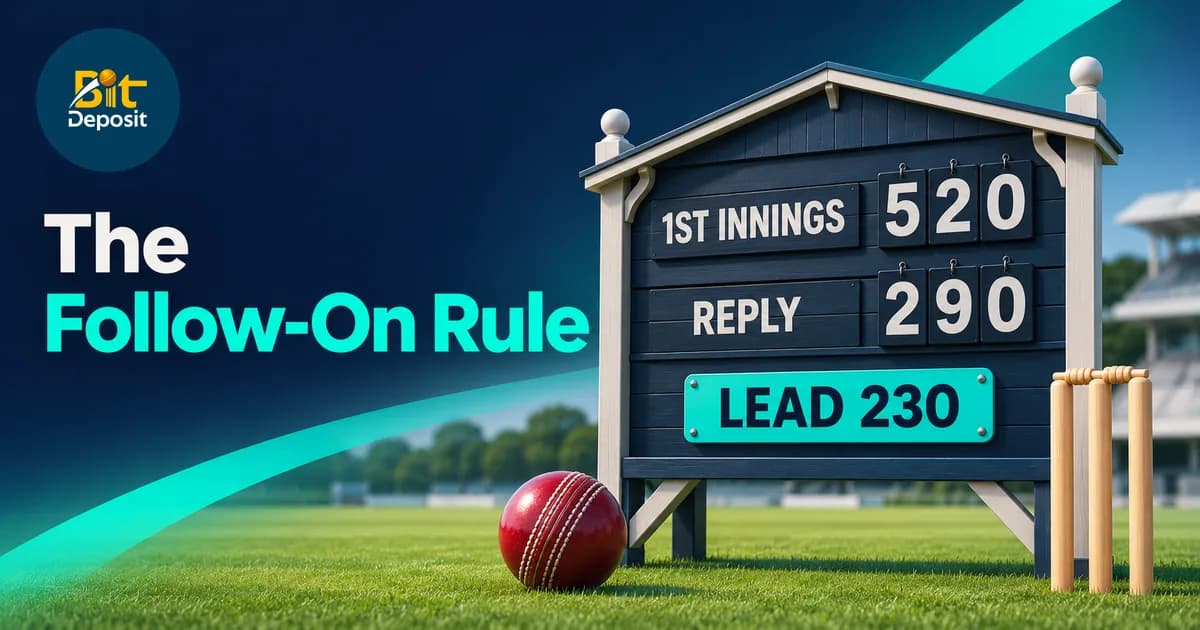
A worked example from a five-day Test shows both outcomes. Team A bats first and scores 520.
- Team B is all out for 290. The lead is 520 - 290 = 230. That is at least 200, so the follow-on is available.
- Team B is all out for 330. The lead is 520 - 330 = 190. That is below 200, so the follow-on is not available.
Team B needs 321 to avoid the follow-on in this match, because 520 - 321 = 199. A total of exactly 320 leaves a lead of 200, and the follow-on is still available.
Suppose Team A enforces the follow-on after the reply of 290. If Team B scores 210 in its second innings, its two totals add up to 290 + 210 = 500. That is still below 520, so Team A wins by an innings and 20 runs without batting again.
What lead is needed to enforce the follow-on?
The lead needed to enforce the follow-on depends on the scheduled length of the match. The table shows the four figures in Law 14, with the highest reply that still allows the follow-on when the side batting first has scored 400.
| Scheduled length of match | Minimum first innings lead | Follow-on available after 400 if the reply is |
|---|---|---|
| 5 days or more | 200 runs | 200 or lower |
| 3 or 4 days | 150 runs | 250 or lower |
| 2 days | 100 runs | 300 or lower |
| 1 day | 75 runs | 325 or lower |
Test matches are scheduled for five days, so the figure is 200. Most domestic first-class matches last four days and use 150.
The figure changes when the start of the match is delayed by whole days. If no play takes place on the first day of a match scheduled for more than one day, the lead is based on the number of days that remain from the start of play. The day on which play begins counts as a whole day, however late it starts.
A five-day Test that loses all of day one becomes a four-day match for this purpose, and the lead needed falls from 200 to 150. Time lost after the match has started does not change the figure. Competitions can also set their own playing conditions, so the regulations of each tournament apply.
Why do captains often decline the follow-on?
Captains often decline the follow-on because bowling twice in a row tires the bowlers and because batting last can be the hardest task in the match.
- Bowler fatigue. The bowlers have just bowled a full innings, and enforcing sends them straight back out with only a short break.
- Batting last on a worn pitch. A pitch usually becomes harder to bat on as the match goes on, and the side that enforced may have to chase a target in the fourth innings.
The case for enforcing is time: it is the fastest route to a win when bad weather is forecast. Wins by a side that followed on are very rare in Test cricket. Two well-known cases are India against Australia at Kolkata in 2001 and New Zealand against England at Wellington in 2023.
How do you check whether the follow-on is available?
The follow-on is available when the first innings lead meets the figure for the length of the match. Follow these steps:
- Confirm that the match has two innings per side.
- Check the scheduled number of days, and subtract any whole days lost before play began.
- Find the lead required: 200, 150, 100 or 75 runs.
- Subtract the second side's first innings total from the first side's total.
- Compare the lead with the figure required.
- Wait for the captain's decision, which is given to the opposing captain and the umpires and cannot be changed afterwards.
The decision matters for betting on the match result. Enforcing the follow-on saves time, so the price for the draw usually gets longer and the price for the leading side gets shorter. A decision to bat again uses up time and can shorten the draw price, especially when rain is forecast.
As an example of a return, a stake of 100 on the draw at odds of 4.00 returns 100 x 4.00 = 400 if the match is drawn.
Common mistakes to avoid
- Thinking the follow-on is automatic. The captain of the side that batted first decides, and can choose to bat again.
- Using 200 runs for every match. The figure is 150 in a 3 or 4 day match, 100 in a 2 day match and 75 in a 1 day match.
- Ignoring days lost at the start. A Test with no play on day one uses the four-day figure of 150.
Frequently asked questions
How many runs are needed for the follow-on in Test cricket?
A first innings lead of at least 200 runs is needed to enforce the follow-on in a Test match scheduled for five days. If the side batting first scores 520, the other side must score 321 or more to avoid it. A lead of exactly 200 is enough.
Is the follow-on compulsory in cricket?
No, the follow-on is not compulsory. Law 14 gives the side that batted first the option, and its captain decides whether to use it. Once the captain has told the opposing captain and the umpires, the decision cannot be changed. Many captains choose to bat again instead.
Does the follow-on rule apply in ODI or T20 cricket?
No, the follow-on rule does not apply in ODI or T20 cricket. Each side bats only once in those formats, so there is no second innings to bring forward. The rule exists only in two-innings matches, such as Test matches and first-class matches.
What happens to the follow-on if the first day is washed out?
The lead required is reduced if no play takes place on the first day. The match is treated as having the number of days that remain from the start of play. A five-day Test that starts on day two is treated as a four-day match, so the lead needed is 150 runs.
Why would a captain not enforce the follow-on?
A captain may not enforce the follow-on because the bowlers are tired after a full innings, or to avoid batting last on a worn pitch. Batting again lets the leading side rest its bowlers, add runs quickly and set a target before bowling a second time.
Play responsibly
Test matches last up to five days, and prices move with every session, so in-play stakes can add up over a long match. Set a budget and a time limit before the first ball, and do not chase a losing bet with another. Betting is for adults only and is not legal everywhere, so check the law where you live. Help is available from GambleAware.
Summary
- The follow-on lets the side batting first make the other side bat again immediately when its lead is large enough.
- The lead needed is 200 runs in a match of 5 days or more, 150 in 3 or 4 days, 100 in 2 days and 75 in 1 day.
- The captain chooses whether to enforce it, and many decline because of bowler fatigue and the risk of batting last.
The full wording of Law 14 is in the MCC Laws of Cricket. The formats are compared in T20 vs ODI vs Test cricket, and innings totals in how to read a cricket scorecard. Match and draw prices are covered in cricket betting markets explained and live betting explained.
18+ only. Play for fun, set your limits and take a break when it stops being fun.
Share this post