
Cricket Powerplay Rules: T20 and ODI Fielding Restrictions
Bitdeposit · 19 November 2026 · 8 min read
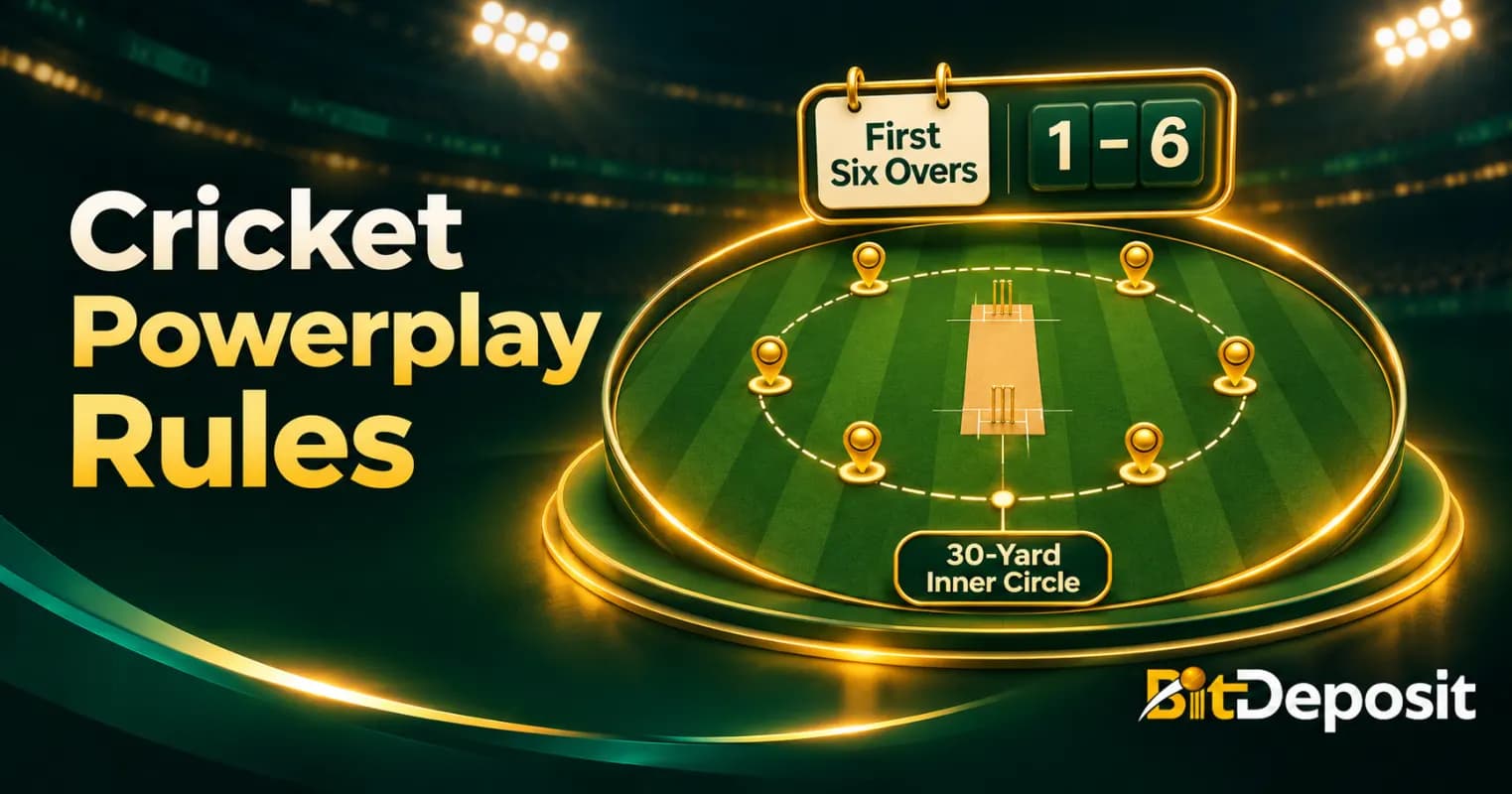
Cricket powerplay rules limit how many fielders may stand outside the 30-yard circle during set blocks of overs in limited-overs matches. In men's Twenty20 (T20) cricket the powerplay is overs 1 to 6, and men's One Day International (ODI) cricket has three powerplays. This guide explains the limits, with a table and a worked example.
Key takeaways
- A powerplay is a block of overs in limited-overs cricket with a cap on the number of fielders outside the 30-yard circle.
- In a men's T20 match, a maximum of 2 fielders may be outside the circle in overs 1 to 6, and a maximum of 5 in overs 7 to 20.
- In a men's ODI, the maximum outside the circle is 2 in overs 1 to 10, 4 in overs 11 to 40 and 5 in overs 41 to 50.
- Breaking a fielding restriction is a no-ball, and Test cricket has no powerplays.
- Each competition's own playing conditions apply, and they can change over time.
What are the cricket powerplay rules?
The cricket powerplay rules are fielding restrictions that cap the number of fielders allowed outside the 30-yard circle during named blocks of overs. The 30-yard circle is an oval marked on the outfield: two semicircles with a radius of 30 yards (27.43 metres), centred on each middle stump and joined by straight lines.
A fielding side has 11 players. The bowler and the wicketkeeper have fixed jobs, which leaves 9 fielders to place. When only 2 of the 9 may stand outside the circle, the other 7 must be inside it, so a shot that clears the inner ring often runs to the boundary.
The standard rules for men's internationals are set by the International Cricket Council (ICC). Women's internationals and domestic leagues publish their own variations.
How does a powerplay work?
A powerplay works by checking the field at the moment the bowler delivers each ball. If too many fielders are outside the circle at that instant, the umpire calls a no-ball. The batting team gets one run and an extra delivery, and in most limited-overs playing conditions the next ball is a free hit.
A worked example shows how a powerplay shapes a T20 innings. A team scores 54/1 (54 runs for the loss of 1 wicket) in its 6-over powerplay and finishes on 168 after 20 overs.
- Powerplay run rate: 54 runs / 6 overs = 9.00 runs per over.
- Runs after the powerplay: 168 - 54 = 114 runs.
- Overs after the powerplay: 20 - 6 = 14 overs.
- Run rate after the powerplay: 114 / 14 = 8.14 runs per over.
The team scored faster with only 2 fielders outside the circle than it did across the other 14 overs.
What are the powerplay overs in T20 and ODI cricket?
The powerplay overs are 1 to 6 in a men's T20 match and 1 to 10, 11 to 40 and 41 to 50 in a men's ODI. The table shows the standard limits for a full-length innings.
| Format | Overs | Maximum fielders outside the circle |
|---|---|---|
| Men's T20: powerplay | 1 to 6 | 2 |
| Men's T20: rest of the innings | 7 to 20 | 5 |
| Men's ODI: powerplay 1 | 1 to 10 | 2 |
| Men's ODI: powerplay 2 | 11 to 40 | 4 |
| Men's ODI: powerplay 3 | 41 to 50 | 5 |
| Test cricket | All overs | No circle limit: there are no powerplays |
One rule applies in every format and every over: no more than 5 fielders may be on the leg side when the ball is bowled.
In a shortened match the powerplay is reduced in proportion to the overs available. In a T20 innings cut to 10 overs, for example, the powerplay is 3 overs instead of 6. ODI powerplays shrink in the same way.
There is no batting powerplay in current ODI rules: it was removed in 2015.
How do you read a powerplay score?
To read a powerplay score, compare the runs and wickets at the end of the powerplay with the rest of the innings. Follow these steps:
- Check the format and the number of overs each team is scheduled to face.
- Find the powerplay overs for that length of innings in the competition's playing conditions.
- Note the score and the wickets lost at the end of the final powerplay over.
- Divide the runs by the overs bowled to get the powerplay run rate.
- Subtract the powerplay runs from the final total to find the runs scored afterwards.
- Compare the two run rates to see where the innings gained or lost pace.
- Weigh the wickets lost, because early wickets usually slow the scoring in later overs.
Powerplay scores also matter in betting. A "first 6 overs" or powerplay runs market sets a line, for example 47.5, and bettors choose over or under. A score of 54/1 wins for over 47.5, and a stake of 100 at odds of 1.85 returns 185. Bookmaker rules differ when rain shortens the powerplay, and such bets are often made void.
Common mistakes to avoid
- Counting the bowler and wicketkeeper as circle fielders. The limits apply to the 9 other fielders, so "2 outside" means 7 inside.
- Thinking the restrictions end after the powerplay. A T20 side may still have only 5 fielders outside the circle in overs 7 to 20.
- Applying T20 numbers to an ODI. An ODI allows 4 fielders outside the circle in overs 11 to 40, not 5.
- Assuming every competition uses the same rules. Women's internationals and domestic leagues set their own powerplay conditions.
Frequently asked questions
How many fielders are allowed outside the circle in a powerplay?
A maximum of 2 fielders are allowed outside the 30-yard circle in a men's T20 powerplay and in the first ODI powerplay. The limit rises to 5 for overs 7 to 20 of a T20. In an ODI it rises to 4 for overs 11 to 40 and 5 for overs 41 to 50.
How many overs is the powerplay in T20 cricket?
The powerplay in a full men's T20 match lasts 6 overs, from over 1 to over 6 of each innings. If the innings is shortened, the powerplay is reduced in proportion: a 10-over innings has a 3-over powerplay. Each competition's playing conditions list the exact figure for every innings length.
What happens if a team breaks the powerplay rules?
If a team has too many fielders outside the circle when the ball is bowled, the umpire calls a no-ball. The batting side receives one run and the ball must be bowled again. In most limited-overs playing conditions the following delivery is a free hit, on which the batter cannot be dismissed in most ways.
Is there a powerplay in Test cricket?
No, Test cricket has no powerplays. The fielding captain may place fielders anywhere inside or outside the 30-yard circle, and the circle is not used. The limit of 5 fielders on the leg side still applies, along with the other fielding rules in the Laws of Cricket.
Is there still a batting powerplay in ODIs?
No, the batting powerplay is no longer part of ODI cricket. It was a block of overs chosen by the batting side, and it was removed in 2015. A men's ODI innings now has three fixed powerplays: overs 1 to 10, overs 11 to 40 and overs 41 to 50.
Play responsibly
Powerplay markets settle within minutes, which makes it easy to place one bet after another. Set a budget before the match starts and stop when it is spent. Never chase losses from one innings by raising stakes in the next. Betting is for adults only and is not legal everywhere, so check the law where you live. Free support is available from GambleAware.
Summary
- Cricket powerplay rules cap the number of fielders outside the 30-yard circle in limited-overs matches.
- Men's T20: a maximum of 2 outside in overs 1 to 6, then 5 in overs 7 to 20.
- Men's ODI: a maximum of 2 outside in overs 1 to 10, 4 in overs 11 to 40 and 5 in overs 41 to 50.
- A breach is a no-ball, Test cricket has no powerplays, and each competition's playing conditions apply.
The three formats are compared in T20 vs ODI vs Test cricket, and scores such as 54/1 are explained in how to read a cricket scorecard. Tied matches are covered in Super Over rules explained. Powerplay runs lines work like any other total, as shown in over/under betting explained.