
Bookmaker Margin Explained: How the Overround Works
Bitdeposit · 17 November 2026 · 6 min read
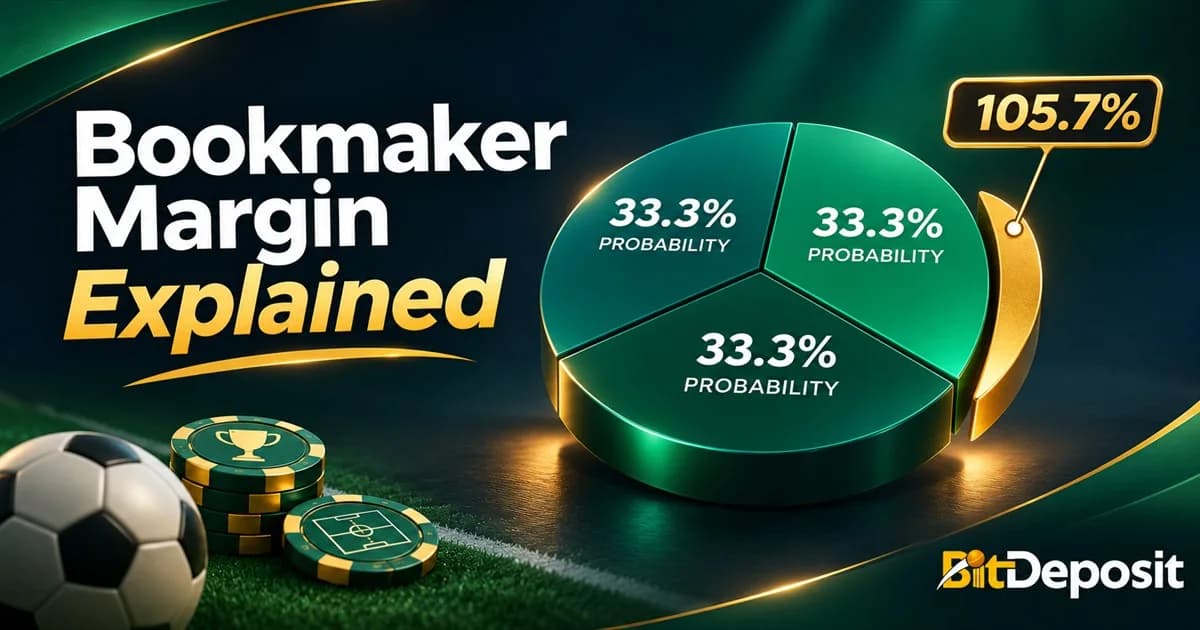
Bookmaker margin is the percentage a bookmaker builds into its odds to make a profit whatever the result. You can find it by adding up the implied probabilities of every outcome in a market: the amount above 100% is the margin, also called the overround. This guide shows how to calculate it and why it matters.
Key takeaways
- The margin is the bookmaker's built-in advantage in a set of odds.
- Implied probability is 1 divided by the decimal odds.
- Add the implied probabilities of all outcomes; the excess over 100% is the margin.
- A two-way market priced at 1.90 on each side has a margin of 5.26%.
- Lower margins mean better prices, but they do not make a bet more likely to win.
What is bookmaker margin?
Bookmaker margin is the difference between the odds a bookmaker offers and the odds that would reflect the true chances of each outcome. It is also known as the overround, the vig or the juice.
In a market with no margin, the implied probabilities of all outcomes would add up to exactly 100%. Bookmakers shorten each price slightly, so the total comes to more than 100%.
How does bookmaker margin work?
Bookmaker margin works by paying out slightly less than fair odds on every outcome. If bets are spread across the outcomes in line with the prices, the bookmaker keeps the margin regardless of the result.
A worked example with a football match priced at 2.50 for the home win, 3.20 for the draw and 2.90 for the away win:
- Home win: 1 / 2.50 = 40.00%.
- Draw: 1 / 3.20 = 31.25%.
- Away win: 1 / 2.90 = 34.48%.
- Total: 40.00 + 31.25 + 34.48 = 105.73%.
- Margin: 105.73 - 100 = 5.73%.
The payout rate is the reverse view: 100 / 105.73 = 94.58%. On average, 94.58 of every 100 staked on this market is returned to bettors.
What are typical margins?
Margins vary by sport, market and bookmaker. The table gives broad, illustrative ranges.
| Market | Typical margin | Why |
|---|---|---|
| Match winner, major football leagues | 2% to 6% | High volume and strong competition |
| Asian handicap and totals | 2% to 5% | Two outcomes, heavily traded |
| Lower leagues and minor sports | 6% to 10% | Less information, lower volume |
| Correct score, first goalscorer | 15% to 30% or more | Many outcomes |
| Accumulators | Compounds with each selection | Margin applies to every leg |
| Live short-term markets | Often higher than pre-match | Faster pricing, more uncertainty |
How do you calculate margin and fair odds?
To calculate the margin, and the fair odds with the margin removed, use the implied probabilities. Follow these steps:
- Convert every price in the market to decimal odds.
- Divide 1 by each price to get its implied probability.
- Add the implied probabilities together.
- Subtract 100% to find the margin.
- To estimate the fair probability of an outcome, divide its implied probability by the total.
- Divide 1 by the fair probability to get the fair odds.
In the example, the home win's fair probability is 40.00 / 105.73 = 37.83%, so the fair odds are about 2.64 against the 2.50 offered. The draw is about 3.38 against 3.20, and the away win about 3.07 against 2.90.
Common mistakes to avoid
- Comparing single prices only. A slightly higher price on one outcome can sit inside a market with a larger overall margin.
- Ignoring the margin in accumulators. Five selections at a 5% margin each carry a combined margin of more than 25%.
- Assuming low margin means a winning bet. The margin affects long-term returns, not the result of any one bet.
- Overlooking high-margin markets. Bets with many outcomes cost far more than simple two-way markets.
- Treating the margin as evenly spread. Bookmakers often take more margin from long shots than from favourites.
Frequently asked questions
What is the overround in betting?
The overround is another name for the bookmaker's margin. It is the amount by which the implied probabilities of all outcomes in a market exceed 100%. A market that adds up to 105% has an overround of 5%, which represents the bookmaker's theoretical profit.
How do you calculate bookmaker margin?
To calculate bookmaker margin, divide 1 by the decimal odds of each outcome, add the results together and subtract 1. For two outcomes priced at 1.90 each, the calculation is 0.5263 + 0.5263 = 1.0526, which gives a margin of 5.26%.
What is a good bookmaker margin?
A good bookmaker margin is below 5% on main markets such as the match winner, Asian handicap and totals. Margins of 2% to 3% are low. Anything above 8% on a main market is high. Specialist markets such as correct score always carry more.
Why do margins differ between markets?
Margins differ because of risk, competition and the number of outcomes. Popular markets attract many customers and are priced tightly. Markets with dozens of outcomes or little information are harder to price, so bookmakers add a larger margin to protect themselves.
Does a lower margin mean I am more likely to win?
No, a lower margin does not change the chance that a bet wins. It means you are paid closer to the fair price when you do win. Over many bets, lower margins reduce the amount lost to the bookmaker, but each result remains uncertain.
Play responsibly
Understanding the margin helps you make informed decisions, but it does not remove the risk of losing: the margin means the odds are always slightly against the bettor. Set a budget before you start, never stake money you cannot afford to lose, and take a break if betting stops being enjoyable. Betting is for adults only, and you should check that it is legal where you live. Independent support is available from organisations such as GambleAware.
Summary
- Margin = sum of implied probabilities minus 100%.
- Payout rate = 100 divided by that sum.
- Fair probability = implied probability divided by the sum.
- Simple two-way markets carry the lowest margins; multi-outcome markets the highest.
Comparing your own estimate with the fair price is the subject of what is value betting. The way margin compounds is shown in what is an accumulator bet, and markets without a built-in margin are covered in what is a betting exchange.