
Rummy Rules for Beginners: Sets, Sequences and Scoring
Bitdeposit · ১৯ নভেম্বর, ২০২৬ · 8 মিনিটে পড়া
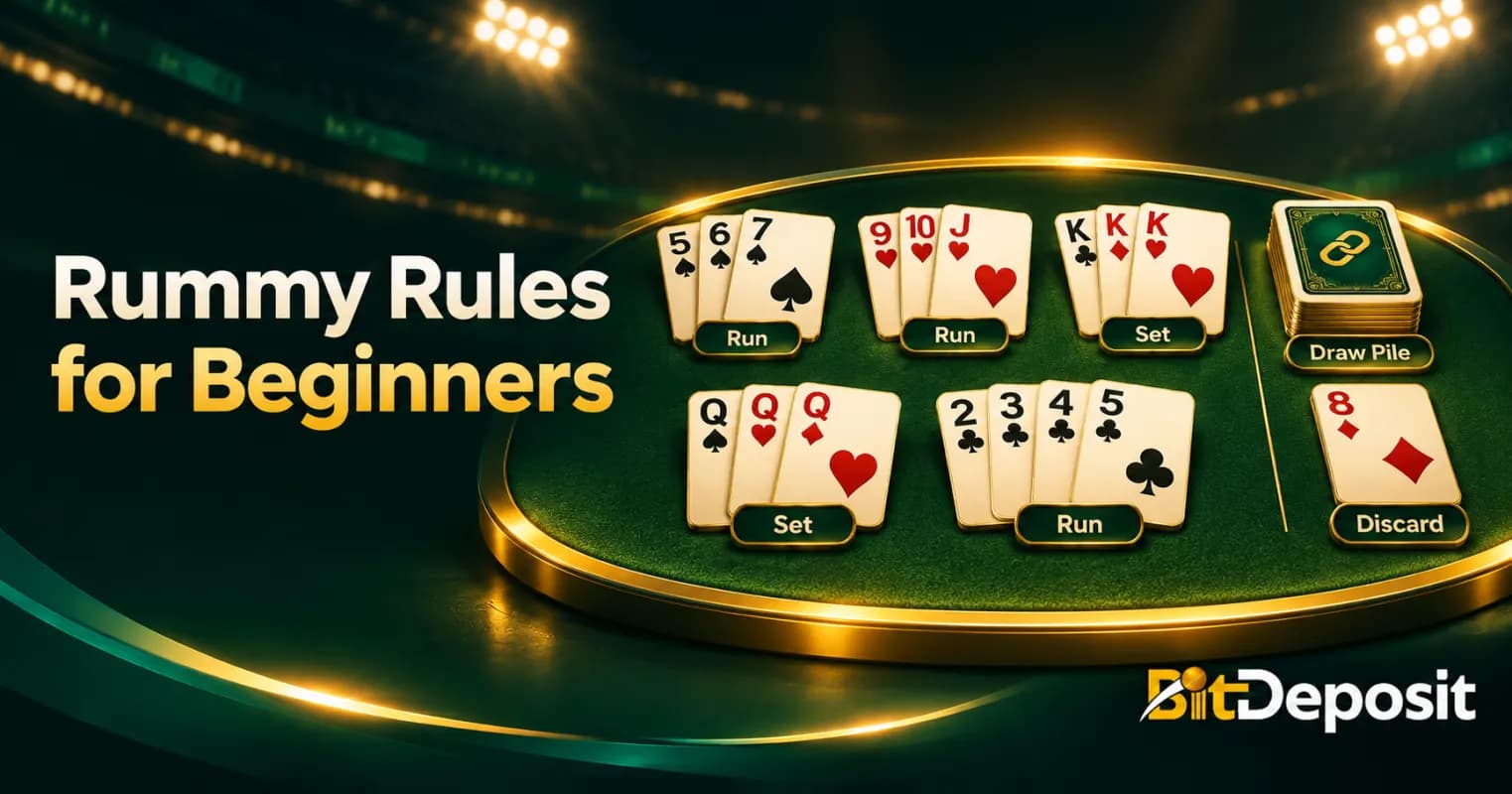
Rummy rules for beginners come down to one aim: arrange all 13 of your cards into valid sequences and sets before your opponents do. On each turn you draw one card and discard one. This guide covers 13-card Indian rummy, including sequences, sets, jokers, a valid declaration and how points are scored.
Key takeaways
- 13-card rummy is played by 2 to 6 players, normally with two standard 52-card decks plus printed jokers.
- A turn has two parts: draw one card from the closed or open pile, then discard one card.
- A valid declaration needs at least two sequences, and at least one of them must be a pure sequence.
- In points rummy the winner scores 0 and each loser counts the cards left outside valid combinations, up to a cap of 80 points.
What is rummy?
Rummy is a draw-and-discard card game in which players try to form their whole hand into groups of related cards. This guide covers 13-card Indian rummy, the most widely played online form in South Asia. Other versions, such as gin rummy and rummy 500, use different hand sizes and scoring.
Rummy involves more skill than pure chance games, because players choose which cards to keep, which to discard and when to leave a deal. The deal itself is still random, so luck matters in any single game.
Rummy rules for beginners: how does a game work?
A game of 13-card rummy works by dealing 13 cards to each player and taking turns to draw and discard until one player makes a valid declaration.
One card is turned face up to start the open (discard) pile. The remaining cards form the closed (stock) pile. One more card is drawn at random as the wild joker, and every card of that rank acts as a joker for the deal, alongside the printed jokers.
On each turn a player draws one card from the closed pile or the open pile, then discards one card to the open pile. A player whose 13 cards form valid combinations declares by placing the 14th card on the finish slot.
There are three types of combination:
| Combination | What it is | Example | Joker used? |
|---|---|---|---|
| Pure sequence | 3 or more consecutive cards of the same suit | 5, 6, 7 of hearts | No |
| Impure sequence | A sequence in which a joker replaces a missing card | 2, 3 of clubs plus a joker | Yes |
| Set | 3 or 4 cards of the same rank in different suits | 8 of hearts, 8 of clubs, 8 of diamonds | Allowed |
The ace can be low (ace, 2, 3) or high (queen, king, ace), but a sequence cannot wrap around (king, ace, 2). A valid declaration needs at least two sequences, at least one of them pure. The remaining cards must also be in sequences or sets.
A worked example of a valid hand, assuming kings are the wild jokers for the deal:
- 5, 6, 7 of hearts: a pure sequence (3 cards).
- 9, 10, jack, queen of spades: a second pure sequence (4 cards).
- 2 of clubs, 3 of clubs and the king of diamonds as a joker: an impure sequence (3 cards).
- 8 of hearts, 8 of clubs, 8 of diamonds: a set (3 cards).
The hand uses 3 + 4 + 3 + 3 = 13 cards and meets the two-sequence rule.
How is rummy scored?
Rummy is scored in points rummy by giving the winner 0 points and counting each loser's cards that are not in valid combinations. Lower is better, and a losing hand is capped at 80 points.
| Card or event | Points |
|---|---|
| Ace, king, queen, jack | 10 each |
| Number cards (2 to 10) | Face value |
| Printed jokers and wild jokers | 0 |
| Maximum for a losing hand | 80 |
| First drop (before drawing a card) | Commonly 20 |
| Middle drop (after drawing at least once) | Commonly 40 |
| Wrong declaration | 80 |
A player with no pure sequence counts every card in the hand, up to 80. A drop means leaving the deal for a fixed penalty instead of playing on. These values vary by site.
A worked example: a losing player holds two valid sequences, one of them pure, plus four unmatched cards: a king, a 9, a 4 and a 2. The hand scores 10 + 9 + 4 + 2 = 25 points.
In cash games, the winnings are the total of the losers' points multiplied by the agreed value per point, less the platform fee. With a point value of 1 and two losers on 35 and 52 points, the winner collects 35 + 52 = 87 before the fee.
How do you play a hand of rummy step by step?
You play a hand of rummy by sorting your cards, building a pure sequence first and then completing the remaining combinations:
- Sort your 13 cards by suit so that possible sequences are easy to see.
- Note the wild joker, and decide whether to play or to take a first drop.
- Draw one card from the closed pile or the open pile.
- Build a pure sequence before anything else, because no other combination counts without it.
- Discard unmatched high cards such as kings and queens if they are not helping.
- Use jokers to complete the second sequence or a set, not the pure sequence.
- Declare only after checking every group, then place the 14th card on the finish slot.
Common mistakes to avoid
- Declaring without a pure sequence. A declaration with no pure sequence is invalid and normally costs the full 80 points.
- Counting a wrap-around run as a sequence. King, ace, 2 is not valid, although ace, 2, 3 and queen, king, ace both are.
- Putting two cards of the same suit in a set. With two decks in play, two 8s of hearts and an 8 of clubs do not form a set.
- Holding high cards for too long. Aces, kings, queens and jacks cost 10 points each if an opponent declares first.
Frequently asked questions
How many cards are dealt in rummy?
Each player is dealt 13 cards in Indian rummy. A player draws a 14th card on each turn and discards one, so the hand returns to 13 cards. Other rummy games differ: gin rummy, for example, is normally played with 10 cards each.
What is a pure sequence in rummy?
A pure sequence is a run of 3 or more consecutive cards of the same suit, made without a joker standing in for a missing card. The 5, 6 and 7 of hearts form a pure sequence. Every valid declaration in 13-card rummy needs at least one pure sequence.
How does the joker work in rummy?
A joker can replace any missing card in an impure sequence or a set. There are two kinds: the printed jokers in the deck and the wild joker, which is a rank chosen at random at the start of each deal. Jokers count as 0 points, and a joker cannot make a sequence pure.
How are points calculated in rummy?
Points are calculated by adding the values of the cards a losing player has not placed in valid combinations. Aces, kings, queens and jacks count 10 each, number cards count their face value and jokers count 0. The total for one hand is capped at 80 points, and the winner scores 0.
Is rummy a game of skill or chance?
Rummy combines both, with more skill than pure chance games such as roulette. Players decide which cards to keep, discard and pick up, and they can track what opponents collect. The deal is random, however, and the legal status of real-money rummy differs by country and state.
Play responsibly
Rummy rewards skill, but any single deal can be lost. Set a budget and a time limit before you play, and never chase losses by moving to a higher point value. Real-money rummy is for adults only, and its legal status differs by country and state, so check local law first. Help is available from GambleAware.
Summary
- 13-card rummy is a draw-and-discard game for 2 to 6 players, with the aim of forming sequences and sets.
- A valid declaration needs at least two sequences, including at least one pure sequence.
- Losers count unmatched cards: 10 for aces, kings, queens and jacks, face value for number cards, 0 for jokers, capped at 80.
- Drop penalties, point values and fees vary by site.
Other card games popular in South Asia are covered in Teen Patti rules and Andar Bahar rules. For poker, see Texas Hold'em rules for beginners and Three Card Poker rules.