
Offside Rule Explained: Football's Law 11 for Beginners
Bitdeposit · ১৯ নভেম্বর, ২০২৬ · 8 মিনিটে পড়া
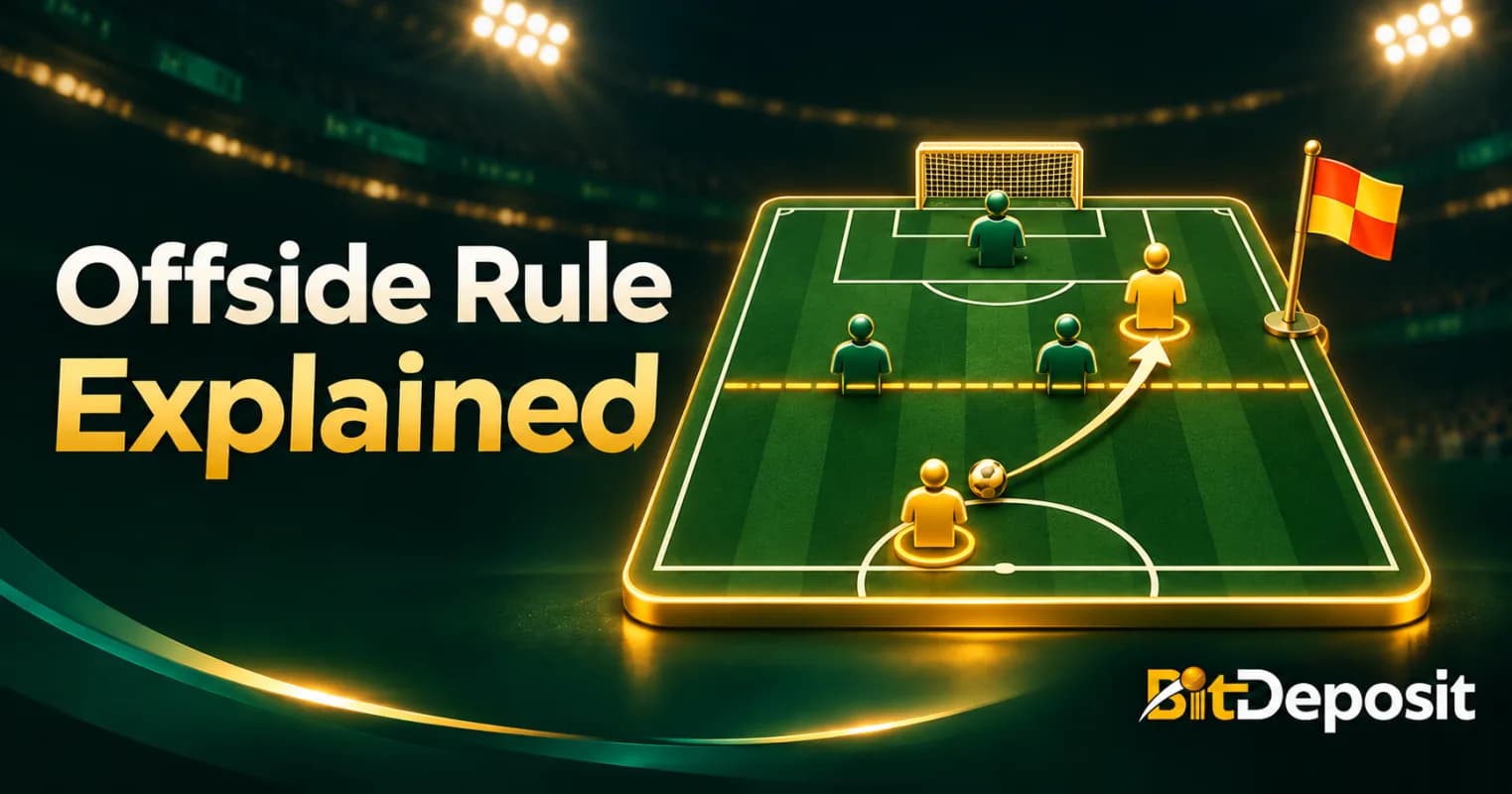
The offside rule explained simply: an attacking player is penalised if, at the moment a team-mate plays the ball, the player is in the opponents' half, nearer to the goal line than both the ball and the second-last opponent, and then becomes involved in play. This guide covers position, offence, exceptions and examples.
Key takeaways
- Offside is Law 11 of the Laws of the Game, written by The International Football Association Board (IFAB).
- A player is in an offside position if any part of the head, body or feet is in the opponents' half and nearer to the goal line than both the ball and the second-last opponent.
- Being in an offside position is not an offence on its own: the player must also become involved in active play.
- There is no offside offence when the ball is received directly from a goal kick, a throw-in or a corner kick.
Offside rule explained: what is offside?
Offside is the football rule that stops attackers from waiting behind the defence for a pass. It is set out in Law 11 of the Laws of the Game.
A player is in an offside position when a team-mate plays or touches the ball and both of the following are true:
- Any part of the player's head, body or feet is in the opponents' half. The halfway line itself does not count.
- Any part of the head, body or feet is nearer to the opponents' goal line than both the ball and the second-last opponent.
Hands and arms are not considered, including those of goalkeepers. A player who is level with the second-last opponent, or level with the last two opponents, is onside.
How does the offside rule work?
The offside rule works by freezing the picture at the moment the ball is played by a team-mate, and then judging whether a player in an offside position becomes involved.
A worked example uses distances from the defending team's goal line. At the moment a midfielder passes forward:
- The ball is 30 metres from the goal line.
- The goalkeeper is 3 metres from the goal line and is the last opponent.
- The deepest outfield defender is 22 metres from the goal line and is the second-last opponent.
- The striker is 20 metres from the goal line.
The striker is in the opponents' half, 10 metres ahead of the ball (30 - 20) and 2 metres ahead of the second-last opponent (22 - 20). The striker is in an offside position, and an offence is given if the striker then receives the pass.
Change one number. If the striker is 22 metres from the goal line when the pass is played, the striker is level with the second-last opponent and is onside.
A player in an offside position commits an offence only by becoming involved in active play in one of three ways:
- Interfering with play: playing or touching the ball passed or touched by a team-mate.
- Interfering with an opponent: for example, blocking the goalkeeper's line of vision or challenging an opponent for the ball.
- Gaining an advantage: playing a ball that rebounds off a goalpost, the crossbar, a match official or an opponent, or that comes from a deliberate save.
When is it an offside offence and when is it not?
It is an offside offence only when a player in an offside position becomes involved in active play, and never when the ball comes directly from a goal kick, a throw-in or a corner kick. The table shows common situations.
| Situation when a team-mate plays the ball | Offside offence? | Reason |
|---|---|---|
| Level with the second-last opponent, receives the pass | No | Level is onside |
| Receives the ball directly from a throw-in | No | Throw-ins, goal kicks and corner kicks are exempt |
| In an offside position, takes no part in the move | No | Position alone is not an offence |
| In an offside position, receives the pass | Yes | Interfering with play |
| In an offside position, blocks the goalkeeper's view | Yes | Interfering with an opponent |
| In an offside position, scores from a rebound off the post | Yes | Gaining an advantage |
Video assistant referee (VAR) systems and semi-automated offside technology are used in some competitions to check tight decisions.
How do you judge an offside call?
To judge an offside call, look at the moment of the pass and not the moment the ball is received. Follow these steps:
- Identify the moment a team-mate plays or touches the ball.
- Check that the ball did not come directly from a goal kick, a throw-in or a corner kick.
- Check whether the attacker is in the opponents' half.
- Find the second-last opponent, counting the goalkeeper as one of the opponents.
- Compare the attacker's head, body and feet with the ball and with that opponent, ignoring hands and arms.
- Decide whether the attacker then played the ball, interfered with an opponent or gained an advantage.
The offside rule also affects betting. A goal disallowed for offside does not count in goalscorer, total goals and both teams to score markets. Some bookmakers offer a total offsides market, where a line such as 3.5 is set and a match with 5 offside offences wins for over 3.5.
Common mistakes to avoid
- Judging the position when the ball is received. The position is judged at the moment the team-mate plays the ball.
- Treating the last outfield defender as the line in every case. The line is the second-last opponent, so two outfield players may set it if the goalkeeper has come forward.
- Thinking a player who is level is offside. A player level with the second-last opponent is onside.
Frequently asked questions
Can you be offside in your own half?
No, a player cannot be in an offside position in their own half. An offside position requires part of the head, body or feet to be in the opponents' half, and the halfway line does not count. A player who starts a run from their own half when the pass is played is onside.
Can you be offside from a throw-in?
No, there is no offside offence if a player receives the ball directly from a throw-in. The same exemption applies to a goal kick and a corner kick. The exemption covers only the first touch: once another team-mate plays the ball, the normal offside rule applies again.
Is a player offside if they are level with the last defender?
No, a player who is level with the second-last opponent is onside. The second-last opponent is usually the deepest outfield defender, because the goalkeeper is usually the last opponent. Only the head, body and feet are compared, so an arm that is ahead of the defender does not make the attacker offside.
What happens after an offside offence?
After an offside offence, the referee awards an indirect free kick to the defending team. The free kick is taken from the place where the offence occurred. A goal cannot be scored directly from an indirect free kick: the ball must touch another player before it enters the goal.
Is it offside if the ball comes off a defender?
It depends on how the ball came off the defender. If the ball rebounds or deflects off an opponent, or comes from a deliberate save, a player in an offside position who then plays it is penalised. If the opponent deliberately played the ball, the attacker is not treated as having gained an advantage.
Play responsibly
Offside decisions can cancel a goal seconds after it is scored, so football results are never certain. Set a budget before you bet, and never chase losses after a disallowed goal or a late decision. Betting is for adults only and is not legal everywhere, so check the law where you live. Support is available from GambleAware.
Summary
- An offside position means being in the opponents' half and nearer to the goal line than both the ball and the second-last opponent when a team-mate plays the ball.
- An offence is given only if that player interferes with play, interferes with an opponent or gains an advantage.
- Goal kicks, throw-ins and corner kicks are exempt, and level is onside.
- The restart is an indirect free kick, and a goal disallowed for offside does not count in betting markets.
Markets that depend on goals standing are covered in both teams to score explained and first goalscorer betting explained. Lines such as over 3.5 are explained in over/under betting explained.