Keno Rules for Beginners: How to Play, Odds and Payouts
A beginner's guide to keno rules: choosing spots from 80 numbers, the draw of 20, how catches are paid and the real chance of each result on a ticket.
Bitdeposit · ২৪ নভেম্বর, ২০২৬ · 8 মিনিটে পড়া
এই পেজে যা আছে
The keno rules for beginners are short: the game has 80 numbers, the player picks a few of them, and 20 numbers are then drawn at random. The more picked numbers that are drawn, the higher the payout. This guide covers how to play, the exact odds, an example paytable and the house edge.
Key takeaways
- Keno has 80 numbers, and 20 of them are drawn in every round.
- The player picks a set of numbers called spots, commonly from 1 to 10, and is paid according to how many are drawn.
- A single picked number is drawn with a chance of 20 in 80, which is 25%.
- A 4-spot ticket catches all 4 numbers with a chance of 4,845 in 1,581,580, about 0.31%.
- Keno usually has a higher house edge than most casino games, and the edge depends on the paytable.
What is keno?
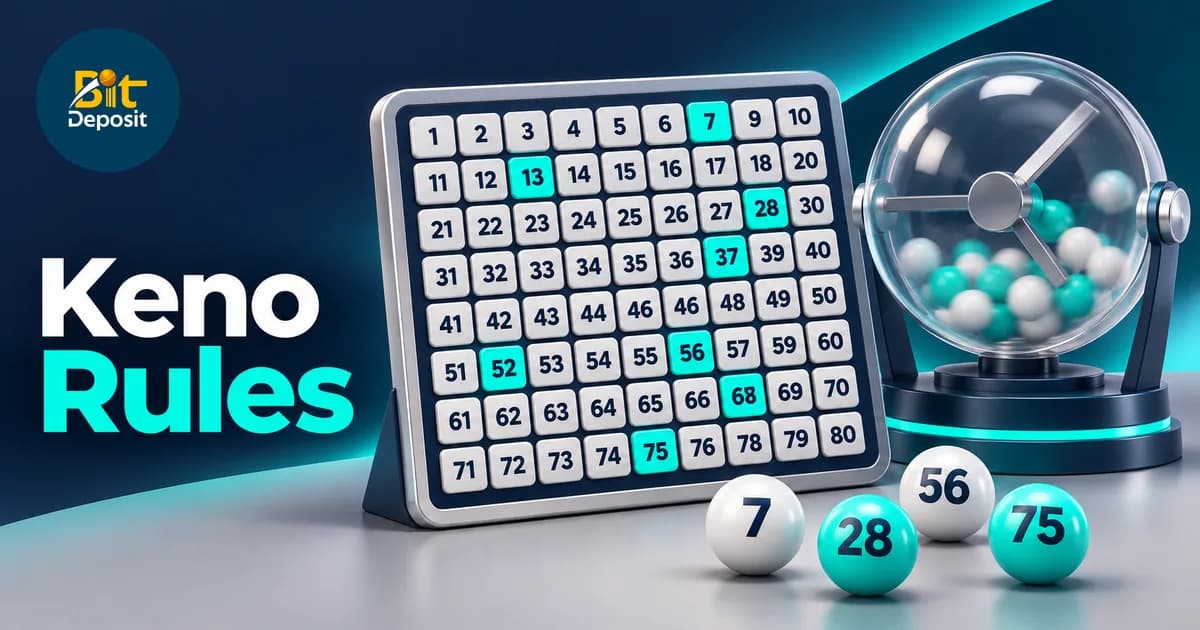
Keno is a lottery-style casino game in which the player picks numbers from 1 to 80 and is paid according to how many of those numbers appear among 20 drawn at random.
A spot is a number that the player picks on the keno card. A ticket with 4 picked numbers is called a 4-spot ticket. Most games allow 1 to 10 spots, and some allow up to 15 or 20.
A catch is a picked number that is also drawn. A paytable is a chart that shows the payout for each number of catches. Each spot count has its own paytable, so a 4-spot ticket and an 8-spot ticket are paid on different scales.
How does keno work?
Keno works by comparing the player's spots with the 20 numbers drawn from 80, then paying the paytable amount for the number of catches. The player controls only the stake, the number of spots and which numbers to pick.
The simplest case is a 1-spot ticket. 20 of the 80 numbers are drawn, so the chance of a catch is 20 / 80 = 25%. The chance of a miss is 60 / 80 = 75%.
Tickets with more spots are worked out with combinations. A combination, written C(n, k), is the number of ways to choose k items from n when the order does not matter. For a 4-spot ticket, the chance of exactly k catches is C(20, k) x C(60, 4 - k) / C(80, 4).
The total number of ways to draw against a 4-spot ticket is C(80, 4) = 1,581,580. The chance of catching all 4 is C(20, 4) = 4,845 ways out of 1,581,580, which is about 0.31%, or roughly 1 in 326. The chance of catching none is C(60, 4) = 487,635 ways, which is 30.83%.
In online keno the 20 numbers come from a random number generator (RNG), which is software that produces unpredictable numbers. In both forms each round is independent, so past draws do not affect the next one.
What are the odds and payouts in keno?
The odds in keno are fixed by the 80 numbers and 20 draws, and the payouts are set by the paytable of each game. The table shows the exact chances for a 4-spot ticket. The payouts are invented for illustration and do not belong to any real game. Each payout is the total returned for a stake of 1.
| Catches | Ways out of 1,581,580 | Chance | Example payout | Ways x payout |
|---|---|---|---|---|
| 0 | 487,635 | 30.83% | 0 | 0 |
| 1 | 684,400 | 43.27% | 0 | 0 |
| 2 | 336,300 | 21.26% | 1 | 336,300 |
| 3 | 68,400 | 4.32% | 5 | 342,000 |
| 4 | 4,845 | 0.31% | 150 | 726,750 |
The ways add up to 487,635 + 684,400 + 336,300 + 68,400 + 4,845 = 1,581,580, so the five chances total 100%. The rounded figures in the table add to 99.99%.
The return is found by adding the last column and dividing by the total ways. The sum is 336,300 + 342,000 + 726,750 = 1,405,050. The return is 1,405,050 / 1,581,580 = 0.8884, or 88.84%. The illustrative game keeps 11.16% of all stakes on average, which is its house edge.
House edge is the average share of each stake that the casino keeps over a very large number of rounds. In keno it is typically between about 5% and 30%, and sometimes higher. Online keno tends to sit at the lower end and live or lounge keno at the higher end. The figure varies by paytable and by the number of spots, so the info screen of each game applies.
The table also shows how often a 4-spot ticket loses. Catching 0 or 1 pays nothing, and those results cover 30.83% + 43.27% = 74.10% of rounds. Catching 2 returns the stake with no profit. On this paytable only 4.63% of rounds make a profit.
How do you play keno step by step?
Keno is played by choosing a stake and a set of numbers, then waiting for the draw. Follow these steps:
- Read the info screen for the paytables and the return to player (RTP), which is the share of all stakes paid back to players over time.
- Choose the stake for each round.
- Decide how many spots to play, commonly from 1 to 10.
- Pick the numbers on the card, or use the quick pick button to have them chosen at random.
- Check the paytable shown for that number of spots.
- Start the draw and watch the 20 numbers appear.
- Compare the catches with the paytable to see the return.
- Stop when the budget or the time limit is reached.
A worked example: a stake of 10 is placed on a 4-spot ticket with the illustrative paytable. Three catches return 10 x 5 = 50, a profit of 40. Two catches return 10 x 1 = 10, which is the stake with no profit.
Common mistakes to avoid
- Picking numbers that seem overdue. Every number has the same 25% chance in each round, whatever happened in earlier draws.
- Assuming more spots give a better chance of winning. More spots give larger top prizes with much smaller chances, and the house edge remains.
- Ignoring the paytable. Two keno games with the same rules can have very different returns.
Frequently asked questions
How many numbers are drawn in keno?
Twenty numbers are drawn in a standard keno round, from a pool of 80. That is a quarter of all the numbers, so any single number has a 25% chance of being drawn. A few variants use different pools or draw sizes, and the rules screen of each game states them.
What are the odds of winning keno?
The odds of winning keno depend on the number of spots and the paytable. A 1-spot ticket catches its number 25% of the time. A 4-spot ticket catches all 4 numbers about 0.31% of the time, or roughly 1 in 326. Catching 10 out of 10 has a chance of about 1 in 8.9 million.
What is the house edge in keno?
The house edge in keno is typically between about 5% and 30%, and it can be higher on some paytables. That is more than most casino table games. The exact figure depends on the paytable and the number of spots, so it differs from one game and provider to another.
Is online keno random?
Yes, online keno is random when it comes from a licensed game provider. A random number generator selects the 20 numbers, and each round is independent of the last. Random does not mean that results look even: some numbers will appear more often than others over short periods, purely by chance.
Do some keno numbers come up more often than others?
No, every keno number has the same chance of being drawn in each round: 20 in 80, or 25%. Lists of hot and cold numbers describe past results only. They do not predict future draws, because the draw has no memory of what came before.
Play responsibly
Keno is a fast game of pure chance with a high house edge, and no choice of numbers changes that. Set a budget and a time limit before you play, and never raise the stake to win back losses. Gambling is for adults only and is not legal everywhere, so check the law where you live. Help is available from GambleAware.
Summary
- Keno has 80 numbers and 20 are drawn: the player picks spots and is paid for the number of catches.
- Each number has a 25% chance of being drawn, and a 4-spot ticket catches all 4 about 0.31% of the time.
- The house edge in keno is typically higher than in most casino games and varies by paytable.
The software behind each draw is covered in what is a random number generator, and the casino's advantage in house edge explained. The belief in overdue numbers is covered in the gambler's fallacy explained.
শুধু ১৮+। মজার জন্য খেলুন, নিজের সীমা ঠিক করে নিন, আর মজা না থাকলে বিরতি নিন।
পোস্টটি শেয়ার করুন