Blackjack Split and Double Down Rules for Beginners
A beginner's guide to splitting and doubling down in blackjack: what each move does, what it costs, how table rules vary and which pairs are usually split.
Bitdeposit · ২৪ নভেম্বর, ২০২৬ · 8 মিনিটে পড়া
এই পেজে যা আছে
Blackjack split and double down rules give the player two extra moves. A double down doubles the stake in return for exactly one more card. A split separates a pair into two hands, with a second stake equal to the first. This guide covers the table rules, the usual pair strategy and worked examples of stakes and returns.
Key takeaways
- A double down doubles the original stake, and the player receives exactly one more card and then must stand.
- A split turns a pair into two separate hands, and each hand carries a stake equal to the original.
- Standard guidance is to always split aces and 8s and never to split 10s or 5s.
What are split and double down in blackjack?
Split and double down in blackjack are optional moves that let a player add a second stake after seeing the first two cards. Blackjack is a card game in which the player tries to finish closer to 21 than the dealer without going over.
A double down is a move that doubles the original stake in exchange for exactly one more card, after which the hand stands. A split is a move that separates two cards of the same value into two hands. The player places a second stake equal to the first, and each hand receives a new second card.
How do split and double down work?
Split and double down work by adding a second stake to the table at a moment chosen by the player. The worked examples use a stake of 100 and even money payouts.
In the double down example, the player holds 6 and 5 for a total of 11, and the dealer's upcard is a 6. An upcard is the dealer's card that is dealt face up. The player doubles, so the total stake becomes 100 + 100 = 200. One card is dealt, a 9, which makes 20.
If the dealer finishes on 18, the player wins and the return is 200 x 2 = 400, a profit of 200. A dealer 20 is a push, which is a tie that returns the stake of 200. A dealer 21 loses the full 200.
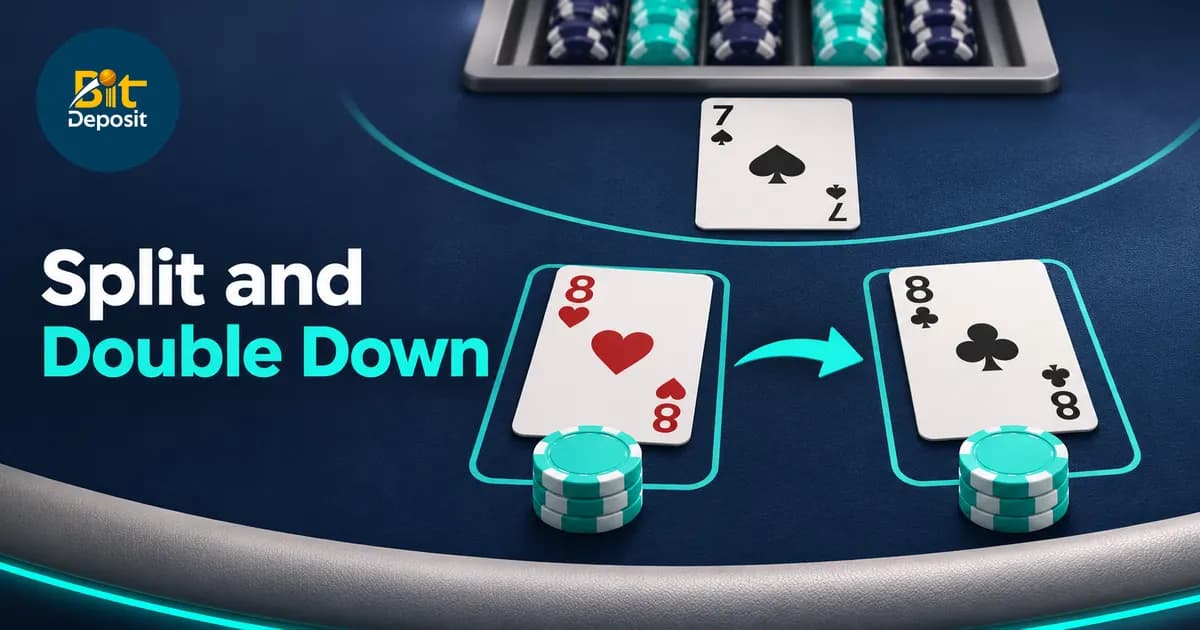
In the split example, the player holds 8 and 8 against a dealer 6 and places a second stake of 100, so 200 is at risk across two hands. The first 8 receives a 10 for 18, and the player stands. The second 8 receives a 5 for 13, the player hits, draws a 10 and goes bust with 23. The dealer finishes on 17.
The first hand wins and returns 100 x 2 = 200. The second hand loses its 100. The total return is 200 on a total stake of 200, so the round breaks even.
Which table rules change splitting and doubling?
The table rules that change splitting and doubling are the limits on when a double is allowed, whether a double is allowed after a split, how often a pair can be re-split and how split aces are treated.
| Rule | Common versions | Effect on the player |
|---|---|---|
| Totals that can double | Any two cards, or only 9 to 11 | Fewer options raise the house edge slightly |
| Double after split | Allowed or not allowed | Allowing it makes more pairs worth splitting |
| Re-splitting | Up to three or four hands, or not allowed | More re-splits slightly favour the player |
| Split aces | Usually one card to each ace | Limits the value of splitting aces |
| 21 after a split | Counts as 21, not as a blackjack | Paid at even money, not 3 to 2 |
A blackjack is an ace with a ten-value card on the first two cards, and it usually pays 3 to 2. A stake of 100 on a blackjack returns 250. An ace and a king made after splitting aces is only a 21, so a stake of 100 on that hand returns 200 if it wins.
House edge is the average share of each stake that the casino keeps over the long run. Each restriction in the table adds a small amount to it.
When should you split pairs in blackjack?
Pairs should be split according to basic strategy, which is the set of plays with the best average result for each hand against each dealer upcard. The table shows the usual multi-deck guidance for a table where the dealer stands on soft 17 and doubling after a split is allowed.
| Pair | Usual play | Split against dealer upcard |
|---|---|---|
| Aces | Always split | 2 to ace |
| 10s | Never split, stand on 20 | None |
| 9s | Split or stand | 2 to 6, 8 and 9 |
| 8s | Always split | 2 to ace |
| 7s | Split or hit | 2 to 7 |
| 6s | Split or hit | 2 to 6 |
| 5s | Never split, treat as a hard 10 | None |
| 4s | Split or hit | 5 and 6 |
| 3s and 2s | Split or hit | 2 to 7 |
A hard hand is a hand with no ace counted as 11. A pair of 5s is a hard 10, which the usual guidance doubles against a dealer 2 to 9.
How do you split or double down step by step?
A split or a double down is made by checking the table rules, placing the second stake and then playing the hand under the limits of that move. Follow these steps:
- Read the table rules for doubling totals, doubling after a split and re-splitting.
- Check that the budget covers a second stake.
- Look at the dealer's upcard before deciding on any move.
- Compare the hand with a basic strategy chart that matches the table rules.
- Place a second stake equal to the first to split or to double.
- Accept the single card on a double, or play each split hand in turn.
Common mistakes to avoid
- Splitting 10s. A total of 20 wins far more often than two hands that each start from 10.
- Doubling without the budget for it. A double or split puts twice the stake at risk.
- Expecting a blackjack payout after a split. An ace and a ten-value card on a split hand is paid as an ordinary 21.
- Believing these moves beat the casino. Splitting and doubling correctly lower the house edge, and the edge still remains.
Frequently asked questions
What does double down mean in blackjack?
Double down means doubling the original stake in return for exactly one more card. The hand stands automatically after that card. A stake of 100 becomes 200, and a winning double returns 400. A losing double costs the full 200.
Can you double down after splitting?
It depends on the table. Many tables allow a double after a split, a rule often shortened to DAS, and others do not. Split aces are the usual exception where it is allowed, because each ace receives only one card.
Should you always split aces and 8s?
Standard basic strategy says to always split aces and 8s. Two aces make a weak total of 2 or 12, while each ace alone can become 21 with a ten-value card. Two 8s make 16, the weakest total in the game, and two hands starting from 8 lose less on average.
Why should you never split 10s?
Splitting 10s gives up a total of 20, which is beaten only by a dealer 21. Each new hand starts from 10 and will often finish lower than 20. Under standard basic strategy, standing on 20 has a better average result than splitting against every dealer upcard.
Do split and double down reduce the house edge?
Yes, splitting and doubling correctly reduce the house edge, because they place more money on strong hands. With basic strategy and favourable rules, the house edge in blackjack is typically around 0.5%. The edge never falls to zero, and single sessions vary widely.
Play responsibly
Splits and doubles raise the amount at risk on a single hand, so a session budget can run out faster than expected. Set a budget and a time limit before you play, and never raise the stake to chase losses. Gambling is for adults only and is not legal everywhere, so check the law where you live. Help is available from GambleAware.
Summary
- A double down doubles the stake for exactly one more card, and a split turns a pair into two hands with two equal stakes.
- Table rules on doubling, re-splitting and split aces vary and change the house edge slightly.
- The usual guidance is to always split aces and 8s and never to split 10s or 5s.
The full chart for every hand is covered in blackjack basic strategy, and the casino's advantage in house edge explained. Planning for double stakes is covered in bankroll management for betting.
শুধু ১৮+। মজার জন্য খেলুন, নিজের সীমা ঠিক করে নিন, আর মজা না থাকলে বিরতি নিন।
পোস্টটি শেয়ার করুন