
Blackjack Basic Strategy for Beginners: Chart and Rules
Bitdeposit · ১৯ নভেম্বর, ২০২৬ · 7 মিনিটে পড়া
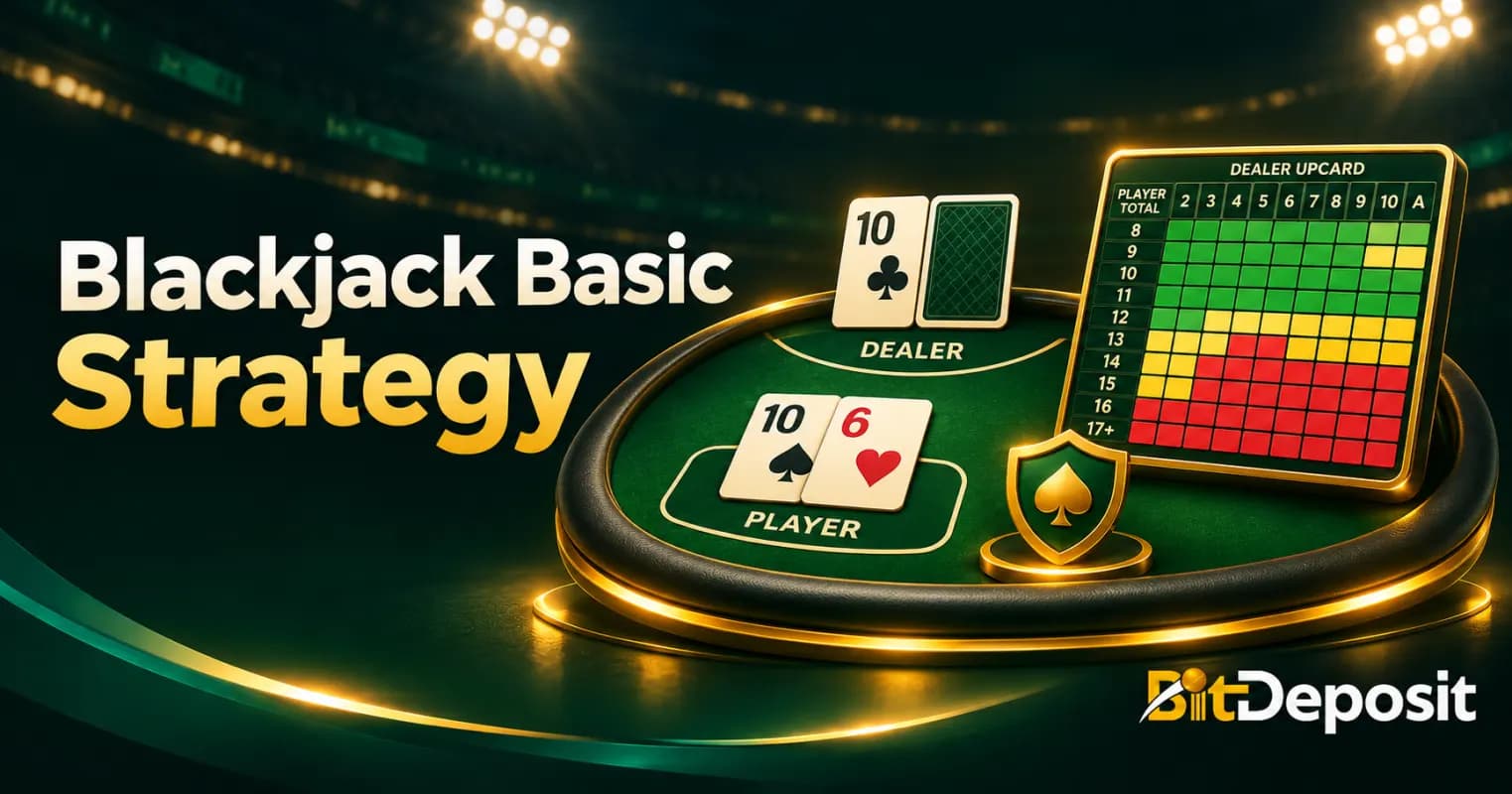
Blackjack basic strategy is the mathematically worked-out way to play every hand, based on your total and the dealer's upcard. It tells you when to hit, stand, double or split. Under common rules it lowers the house edge to roughly 0.5%, but it does not remove it. This guide gives the chart and how to use it.
Key takeaways
- It reduces the house edge to roughly 0.5% under common rules, but the casino still has the advantage.
- The correct chart depends on the table rules: the number of decks, whether the dealer stands on soft 17 and whether doubling after a split is allowed.
- Always split aces and 8s, never split 10s or 5s, and do not take insurance.
- Basic strategy minimises losses over the long run and does not guarantee a win in any session.
What is blackjack basic strategy?
Blackjack basic strategy is a chart of the best decision for every hand, worked out by calculating the long-run result of each option. The upcard is the one dealer card dealt face up, and it is the only information the chart uses besides your own hand.
Four terms are needed to read the chart:
- Hit means taking another card, and stand means taking no more cards.
- Double means doubling the stake in return for exactly one more card.
- Split means separating a pair into two hands, each with its own stake.
- A soft hand contains an ace counted as 11, such as ace-6 (soft 17). A hard hand has no ace, or an ace that must count as 1.
The chart in this guide assumes a multi-deck game in which the dealer stands on soft 17, doubling after a split is allowed and surrender is not offered.
How does basic strategy work?
Basic strategy works by choosing, for each situation, the option that loses the least or wins the most on average over a very large number of hands.
A worked example shows what a house edge of roughly 0.5% means. A player who bets 10 per hand for 100 hands wagers 10 x 100 = 1,000 in total. The expected loss is 1,000 x 0.005 = 5. That figure is a long-run average: the result of any one session can be far above or below it.
A second example shows the limits of the method. Hard 16 against a dealer 10 is a losing hand either way. Hitting simply loses slightly less often than standing over the long run, so the chart says hit. Basic strategy minimises loss in bad spots; it cannot turn them into winning ones.
What does the blackjack basic strategy chart say?
The blackjack basic strategy chart says how to play hard totals, soft totals and pairs against each dealer upcard. In the tables, "10" means any ten-value card (10, jack, queen or king).
Hard totals:
| Your hand | Play | Otherwise |
|---|---|---|
| Hard 17 or more | Always stand | None |
| Hard 13 to 16 | Stand against 2-6 | Hit against 7-ace |
| Hard 12 | Stand against 4-6 | Hit against 2, 3 and 7-ace |
| Hard 11 | Double against 2-10 | Hit against an ace |
| Hard 10 | Double against 2-9 | Hit against 10 and ace |
| Hard 9 | Double against 3-6 | Hit against 2 and 7-ace |
| Hard 8 or less | Always hit | None |
Soft totals:
| Your hand | Play | Otherwise |
|---|---|---|
| Soft 19 and soft 20 | Always stand | None |
| Soft 18 (ace-7) | Double against 3-6 | Stand against 2, 7 and 8; hit against 9, 10 and ace |
| Soft 17 (ace-6) | Double against 3-6 | Hit |
| Soft 15 and soft 16 | Double against 4-6 | Hit |
| Soft 13 and soft 14 | Double against 5-6 | Hit |
Pairs:
| Your pair | Play | Otherwise |
|---|---|---|
| Aces and 8s | Always split | None |
| 10s | Never split: stand on 20 | None |
| 5s | Never split: play as hard 10 | None |
| 9s | Split against 2-6, 8 and 9 | Stand against 7, 10 and ace |
| 7s | Split against 2-7 | Hit against 8-ace |
| 6s | Split against 2-6 | Hit against 7-ace |
| 4s | Split against 5 and 6 | Hit |
| 2s and 3s | Split against 2-7 | Hit against 8-ace |
Doubling is normally allowed only on the first two cards. When a hand of three or more cards reaches a total where the chart says double, hit instead, except with soft 18, where the play is to stand.
How do you use basic strategy at the table?
To use basic strategy at the table, find your hand type first and then read across to the dealer's upcard. Follow these steps:
- Read the table rules and choose a chart that matches the decks, the dealer's action on soft 17 and the doubling rules.
- Check for a pair first and decide whether the chart says to split.
- Check for an ace counted as 11 and use the soft totals table if you have one.
- Use the hard totals table for every other hand.
- Repeat the check after each new card, because a soft hand can become a hard hand.
- Decline insurance whenever it is offered.
Insurance is a separate side bet, offered when the dealer shows an ace, with a house edge of over 7% in multi-deck games.
Common mistakes to avoid
- Standing on hard 12 against a dealer 2 or 3. The chart says hit, and stand only against 4-6.
- Playing soft hands as hard hands. Soft 17 cannot go bust with one more card, so the chart never says to stand on it.
- Using one chart for every table. A game where the dealer hits soft 17, or a single-deck game, needs a different chart.
Frequently asked questions
Does basic strategy guarantee a win in blackjack?
No, basic strategy does not guarantee a win. It reduces the house edge to roughly 0.5% under common rules, but the casino keeps the advantage. Over a long period, a player using basic strategy should still expect to lose slightly more than they win.
Should you hit or stand on 16 against a dealer 10?
Basic strategy says to hit hard 16 against a dealer 10 when surrender is not offered. The hand loses more often than it wins whichever option is chosen. Hitting loses slightly less often than standing over the long run, which makes it the better of two poor options.
Should you ever take insurance in blackjack?
No, basic strategy says never to take insurance. Insurance is a side bet that the dealer's face-down card is a ten-value card, and it pays 2 to 1. In multi-deck games its house edge is over 7%. The same answer applies to "even money", which is insurance offered on a player blackjack.
Is the basic strategy chart the same for every blackjack table?
No, the correct chart depends on the table rules. The number of decks, whether the dealer stands or hits on soft 17, whether doubling after a split is allowed and whether surrender is offered all change some decisions. Most plays are the same on every chart, but the borderline hands differ.
Does basic strategy work in online and live dealer blackjack?
Yes, basic strategy applies to online and live dealer blackjack, as long as the chart matches the rules of the game. Card counting is a different topic, and it does not work on online games that shuffle every hand. The published rules of each game show the decks used and the dealer's rules.
Play responsibly
Basic strategy lowers the cost of playing blackjack, but the house edge remains and losing sessions are normal. Set a budget before you sit down, and never chase losses by raising stakes. Casino games are for adults only and are not legal everywhere, so check the law where you live. Support is available from GambleAware.
Summary
- It lowers the house edge to roughly 0.5% under common rules without removing it.
- Always split aces and 8s, never split 10s or 5s, and decline insurance.
- The right chart depends on the table rules, so check them before you play.
The casino's built-in advantage is covered in house edge explained. How blackjack is dealt online is described in how live dealer games work and what is a random number generator. Setting a session budget is explained in bankroll management for betting.