
Baccarat Third Card Rule Explained: Drawing Rules and Chart
Bitdeposit · ২৩ নভেম্বর, ২০২৬ · 8 মিনিটে পড়া
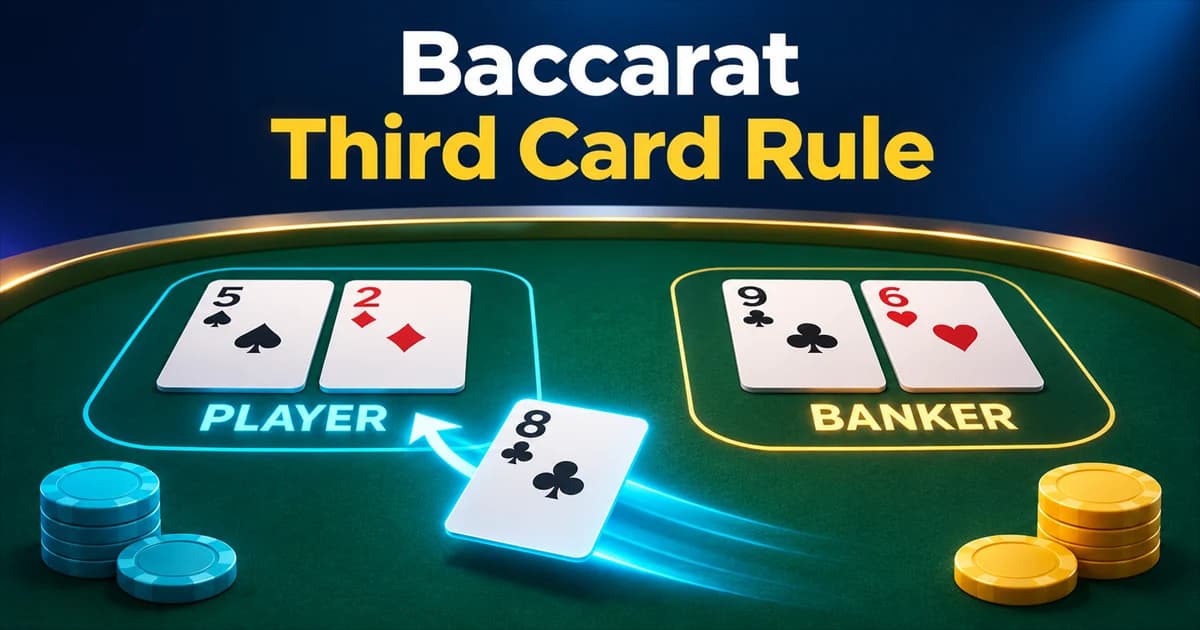
The baccarat third card rule is the fixed set of drawing rules that decides whether the Player hand and the Banker hand take a third card. The Player draws on 0 to 5, and the Banker's move depends on its own total and the Player's third card. This guide covers the chart, worked hands and the house edge.
Key takeaways
- A natural, which is a total of 8 or 9 on the first two cards of either hand, ends the round with no more cards.
- The Player hand draws a third card on a total of 0 to 5 and stands on 6 or 7.
- If the Player stands, the Banker hand draws on 0 to 5 and stands on 6 or 7.
- The dealer applies the rules automatically, so the bettor makes no drawing decisions.
What is the baccarat third card rule?
The baccarat third card rule is a fixed table of instructions that tells the dealer when each hand must draw one more card and when it must stand. It is used in punto banco, the standard casino version of baccarat, in which bettors back the Player hand, the Banker hand or a Tie.
An ace counts 1, cards from 2 to 9 count their face value, and tens, jacks, queens and kings count 0. Only the last digit of a total counts, so 7 + 8 = 15 is a total of 5. The hand closer to 9 wins.
How does the third card rule work?
The third card rule works as a short sequence of checks that the dealer makes in the same order every round:
- Two cards are dealt to the Player hand and two to the Banker hand.
- If either hand totals 8 or 9, the round ends at once. This is called a natural.
- If there is no natural, the Player hand acts first: it draws on 0 to 5 and stands on 6 or 7.
- If the Player stood, the Banker draws on 0 to 5 and stands on 6 or 7.
- If the Player drew, the Banker draws or stands according to the Banker chart.
Hand 1: the Player stands. The Player holds 7 and a king, a total of 7 + 0 = 7, and stands. The Banker holds 4 and an ace, a total of 4 + 1 = 5, and must draw. The third card is a 9, so the Banker has 5 + 9 = 14, which counts as 4. The Player wins by 7 to 4.
Hand 2: the Banker stands on 3. The Player holds 2 and 2, a total of 4, and draws an 8. The new total is 4 + 8 = 12, which counts as 2. The Banker holds a queen and 3, a total of 3. A Banker total of 3 draws unless the Player's third card is an 8, so the Banker stands and wins by 3 to 2.
Hand 3: both hands draw. The Player holds a jack and 5, a total of 5, and draws a 4 to make 9. The Banker holds 6 and 9, which is 15 and counts as 5. A Banker total of 5 draws against a third card of 4 to 7, so the Banker draws a 2 and makes 7. The Player wins by 9 to 7.
What is the Banker third card chart?
The Banker third card chart shows whether the Banker draws or stands for each Banker total and each value of the Player's third card. It applies only when the Player has taken a third card. A third card value of 0 means a ten, jack, queen or king.
| Banker total | Banker draws if the Player's third card is | Banker stands if the Player's third card is |
|---|---|---|
| 0, 1 or 2 | Any card | Never |
| 3 | 0, 1, 2, 3, 4, 5, 6, 7 or 9 | 8 |
| 4 | 2, 3, 4, 5, 6 or 7 | 0, 1, 8 or 9 |
| 5 | 4, 5, 6 or 7 | 0, 1, 2, 3, 8 or 9 |
| 6 | 6 or 7 | 0, 1, 2, 3, 4, 5, 8 or 9 |
| 7 | Never | Any card |
The Banker acts last and uses the Player's third card, so it wins slightly more often than the Player.
| Bet | Usual payout | House edge (8 decks) |
|---|---|---|
| Banker | 1 to 1 less 5% commission | 1.06% |
| Player | 1 to 1 | 1.24% |
| Tie | 8 to 1 | 14.36% |
A winning stake of 100 returns 195 on Banker, 200 on Player and 900 on Tie. Payouts, commission and side bets vary by casino and game provider, so the table rules shown at each game apply.
How do you follow a baccarat hand step by step?
A baccarat hand is followed by checking the totals in the same order as the dealer:
- Add the first two cards of each hand and keep only the last digit.
- Check for a natural 8 or 9, which ends the round.
- Look at the Player total: 0 to 5 draws and 6 or 7 stands.
- Apply the same rule to the Banker if the Player stood.
- Note the value of the Player's third card, not the Player's new total.
- Find the Banker total in the chart to see whether the Banker draws.
- Compare the final totals: the hand closer to 9 wins, and equal totals tie.
Common mistakes to avoid
- Using the Player's new total in the chart. The Banker's decision depends on the value of the Player's third card, not on the Player's total after drawing.
- Thinking the bettor chooses whether to draw. In punto banco every draw is automatic, and the only decision is which bet to place before the deal.
- Treating the Tie as good value. A payout of 8 to 1 carries a house edge of 14.36%, far higher than the Banker or Player bet.
Frequently asked questions
When does the Player draw a third card in baccarat?
The Player hand draws a third card when its first two cards total 0 to 5, and it stands on 6 or 7. The exception is a natural: if either hand has 8 or 9 after two cards, the round ends and nobody draws.
When does the Banker draw a third card in baccarat?
The Banker draws on 0 to 5 and stands on 6 or 7 when the Player has stood. When the Player has drawn, the Banker always draws on 0 to 2, always stands on 7, and on totals of 3 to 6 follows the chart based on the Player's third card.
What is a natural in baccarat?
A natural in baccarat is a total of 8 or 9 on the first two cards of either the Player hand or the Banker hand. A natural ends the round immediately and no third cards are dealt. A natural 9 beats a natural 8, and two equal naturals are a tie.
Can a baccarat hand have more than three cards?
No, a baccarat hand never has more than three cards. Each hand starts with two cards and can take one more at most under the drawing rules. A round therefore uses four, five or six cards in total, never more.
Is the third card rule the same in every casino?
The third card rule is the same in standard punto banco tables, both live and online. Other things differ: no-commission versions change the Banker payout, and Tie payouts can be 8 to 1 or 9 to 1. The rules shown at the table apply.
Play responsibly
The third card rule is fixed, so no choice made during a hand changes the result, and every baccarat bet carries a house edge. Set a budget before you play, and stop when it is spent. Gambling is for adults only and is not legal everywhere, so check the law where you live. Help is available from GambleAware.
Summary
- A natural 8 or 9 on the first two cards ends the round with no more cards.
- The Player draws on 0 to 5 and stands on 6 or 7, and the Banker does the same when the Player stands.
- When the Player draws, the Banker follows the chart based on the Player's third card.
- The rules are automatic, and the house edge with 8 decks is 1.06% on Banker, 1.24% on Player and 14.36% on Tie.
The full game, including bets and payouts, is covered in baccarat rules explained, and the casino's advantage is explained in house edge explained. For setting limits, see bankroll management in betting.