
Video Poker Rules for Beginners: Jacks or Better Explained
Bitdeposit · ১৭ নভেম্বর, ২০২৬ · 6 মিনিটে পড়া
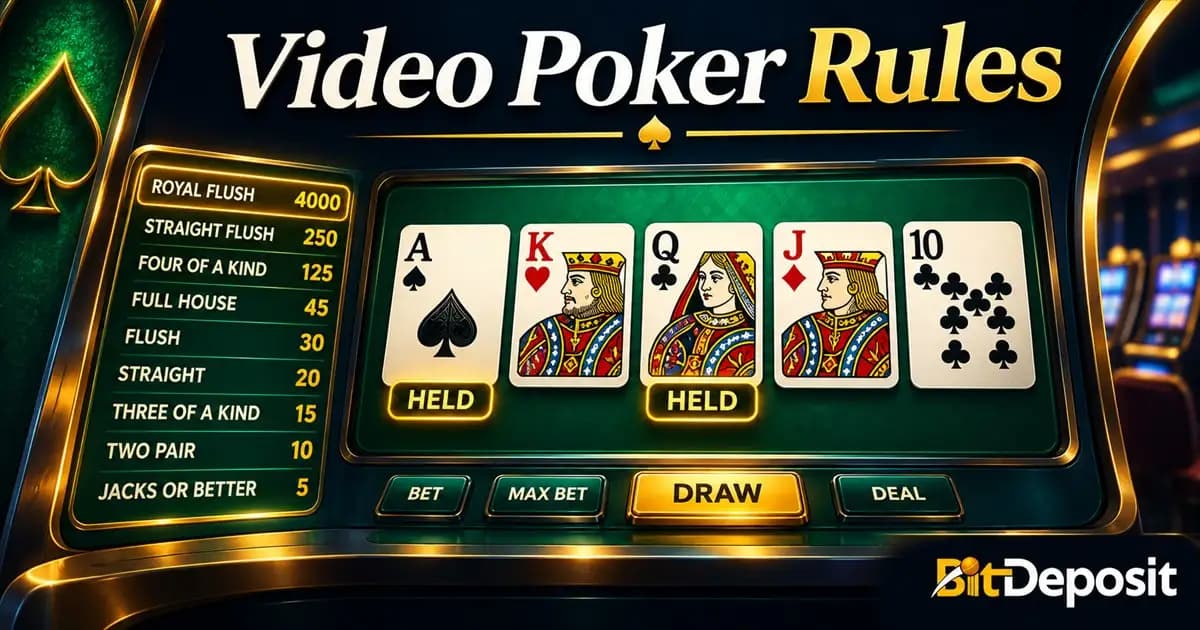
Video poker is a casino game based on five-card draw poker, played on a machine or screen against a fixed paytable. You are dealt five cards, choose which to keep, replace the rest once, and are paid if the final hand matches a winning combination. This guide explains the rules using Jacks or Better, the most common version.
Key takeaways
- Video poker is played alone against a paytable, not against other players or a dealer.
- You are dealt five cards and may replace any of them once.
- In Jacks or Better, the lowest paying hand is a pair of jacks or higher.
- A "9/6" Jacks or Better game returns 99.54% with correct play, one of the highest figures in a casino.
- The return depends on the paytable, so the same game can pay very differently on different machines.
What is video poker?
Video poker is a single-player game that combines the hand rankings of poker with the format of a slot machine. Unlike a slot, your decisions affect the result, because you choose which cards to hold.
There are many versions, including Deuces Wild and Bonus Poker. Jacks or Better is the standard game and the best one to learn first.
How do you play video poker?
You play video poker by making one decision per hand: which cards to hold. A hand follows these steps:
- Choose your stake, usually between one and five coins.
- Press deal, and five cards appear face up.
- Select the cards you want to hold.
- Press draw; the cards you did not hold are replaced from the same deck.
- The final five cards are compared with the paytable.
- If the hand qualifies, you are paid according to the paytable.
Each hand is dealt from a freshly shuffled 52-card deck, so previous hands have no effect.
What does the Jacks or Better paytable pay?
The paytable lists the payout for each winning hand. The table shows a full-pay "9/6" Jacks or Better game, named after its payouts of 9 for a full house and 6 for a flush.
| Hand | Description | Payout per coin |
|---|---|---|
| Royal flush | 10, jack, queen, king, ace of one suit | 250 (800 with five coins) |
| Straight flush | Five consecutive cards of one suit | 50 |
| Four of a kind | Four cards of the same rank | 25 |
| Full house | Three of a kind plus a pair | 9 |
| Flush | Five cards of one suit | 6 |
| Straight | Five consecutive cards of mixed suits | 4 |
| Three of a kind | Three cards of the same rank | 3 |
| Two pair | Two different pairs | 2 |
| Jacks or better | A pair of jacks, queens, kings or aces | 1 |
Payouts are shown as the total returned per coin staked, so a pair of jacks returns the stake.
Why the paytable matters
A 9/6 game returns 99.54% with correct play. A common reduced version, 8/5, pays 8 for a full house and 5 for a flush and returns about 97.30%. Always check these two figures before you play.
How do you decide which cards to hold?
To decide which cards to hold, follow a fixed order of priorities. A simplified version for Jacks or Better is:
- Hold any hand that already pays, unless you have four cards to a royal flush.
- Hold four cards to a royal flush, even if it means breaking a paying hand.
- Hold four cards to a flush in preference to a low pair.
- Hold a low pair in preference to a single high card.
- Hold a low pair in preference to four cards to a straight.
- With nothing else, hold one or two high cards (jack or better).
- If you have none of these, draw five new cards.
Common mistakes to avoid
- Playing a poor paytable. A drop from 9/6 to 8/5 costs more than 2% of every stake.
- Betting fewer than five coins. The royal flush pays 800 per coin only at the maximum stake.
- Holding a kicker. Keeping an ace alongside a low pair reduces the chance of improving.
- Breaking a low pair for one high card. The pair is worth more on average.
- Playing too fast. Video poker deals hundreds of hands an hour, which multiplies the effect of the house edge.
Frequently asked questions
What does Jacks or Better mean?
Jacks or Better means the lowest hand that pays is a pair of jacks or any higher pair. A pair of tens or lower pays nothing. It is also the name of the standard version of video poker, in which no wild cards are used.
What is a 9/6 video poker machine?
A 9/6 video poker machine is a Jacks or Better game that pays 9 coins for a full house and 6 coins for a flush per coin staked. It is called full pay and returns 99.54% with correct strategy. Machines paying 8/5 or less have a lower return.
Is video poker a game of skill?
Video poker involves both chance and skill. The cards are dealt at random, but your choice of which cards to hold changes the expected return. Playing the correct strategy on a good paytable gives a much higher return than guessing.
Why should you bet five coins in video poker?
You should bet five coins because the royal flush pays a bonus at the maximum stake: 800 per coin instead of 250. That bonus is included in the published return, so betting fewer coins lowers it. If five coins is too much, choose a lower coin value.
How is video poker different from slots?
Video poker differs from slots in that the player makes decisions that affect the outcome, and the odds can be calculated from the paytable because a standard deck is used. Slots require no decisions. The best video poker games also have a higher return than most slots.
Play responsibly
Knowing the rules and the paytable helps you make informed decisions, but video poker still has a house edge and is played quickly. Set a budget before you start, never stake money you cannot afford to lose, and take a break if playing stops being enjoyable. Gambling is for adults only, and you should check that it is legal where you live. Independent support is available from organisations such as GambleAware.
Summary
- Five cards are dealt, you hold what you want, and the rest are replaced once.
- Jacks or Better pays from a pair of jacks upwards.
- A 9/6 paytable returns 99.54% with correct play; 8/5 returns about 97.30%.
- Bet five coins to qualify for the full royal flush payout.
The hands are ranked as in the poker hand rankings. Return percentages are explained in what is RTP in slots, and poker against other players is covered in the Texas Hold'em rules for beginners. Background on the game is available on Wikipedia.