
Slot Volatility Explained: Low, Medium and High Variance
Bitdeposit · ১৭ নভেম্বর, ২০২৬ · 6 মিনিটে পড়া
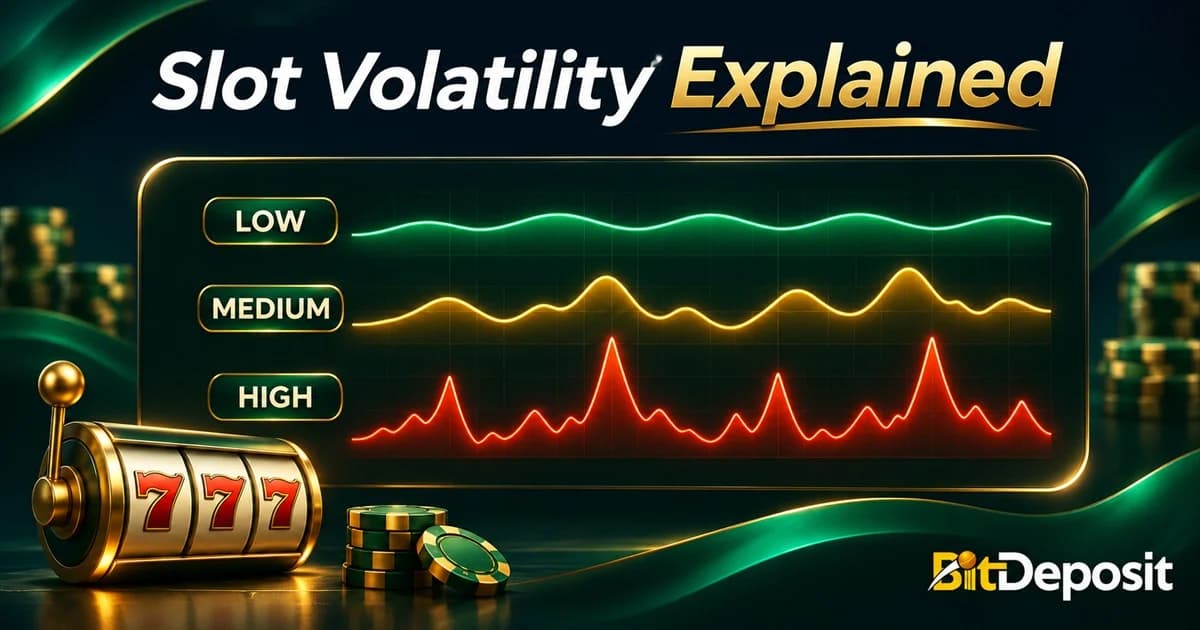
Slot volatility describes how a slot pays out: how often wins occur and how large they tend to be. A low-volatility slot pays small wins frequently. A high-volatility slot pays rarely, but its wins can be much larger. Volatility does not change the long-term return of the game. This guide explains the three levels.
Key takeaways
- Volatility, also called variance, measures how wins are spread, not how much is returned overall.
- Low volatility means frequent small wins; high volatility means rare large wins.
- Two slots with the same RTP can have very different volatility.
- High-volatility slots can use up a budget quickly during a losing run.
- The volatility level is often shown in the game's information screen.
What is slot volatility?
Slot volatility is a measure of the risk in a slot game: how far short-term results can move away from the average. It is set by the game's design, in particular by the paytable and the way bonus features pay.
The term variance means the same thing. Game providers usually describe volatility as low, medium or high, and some use a scale of one to five or one to ten.
How does slot volatility work?
Slot volatility works by concentrating the game's returns into either many small wins or a few large ones. The overall percentage returned to players can be identical.
A worked example with two slots that both have an RTP of 96%, each played for 200 spins at a stake of 1, starting with a balance of 200:
- Low-volatility slot: a win occurs about every third spin, usually between 1 and 5 times the stake. The balance moves up and down gently and might finish near 180 to 210.
- High-volatility slot: a win occurs about every fifth or sixth spin, and most are small, but a bonus round can pay 200 times the stake or more. The balance might finish near 40, or near 500.
Both games return 96% on average across millions of spins. In a single session the high-volatility game produces a much wider range of results.
How do the volatility levels compare?
The table compares the three levels.
| Feature | Low volatility | Medium volatility | High volatility |
|---|---|---|---|
| How often wins occur | Often | Moderately often | Rarely |
| Typical win size | Small | Mixed | Mostly small, occasionally very large |
| Maximum win | Usually under 1,000x the stake | About 1,000x to 5,000x | Often 5,000x or more |
| Balance movement | Gentle | Moderate | Sharp swings |
| Length of losing runs | Short | Medium | Long |
| Budget needed for a session | Smaller | Medium | Larger |
How do you find a slot's volatility?
To find a slot's volatility, check the game's own information first. Follow these steps:
- Open the information or help screen and look for "volatility" or "variance".
- Check the maximum win; a very high figure suggests high volatility.
- Look at the paytable: a large gap between the top prize and ordinary wins points to high volatility.
- Note how much of the game's value sits in a bonus round or free spins.
- Check the hit frequency if it is published; a low figure means fewer wins.
- Try the demo version to see how the balance behaves.
Common mistakes to avoid
- Confusing volatility with RTP. Volatility describes the pattern of wins; RTP describes the amount returned.
- Playing high volatility with a small budget. Long losing runs are normal and can end a session quickly.
- Raising the stake to chase a bonus round. The chance of triggering a feature does not rise with the stake.
- Assuming a big win is due. Each spin is independent, however long the losing run.
- Treating low volatility as safe. A low-volatility slot still has a house edge and loses money on average.
Frequently asked questions
Is high or low volatility better?
Neither is better; they suit different preferences. Low volatility gives longer play and steadier results for a given budget. High volatility offers the chance of a large win but with long losing runs and a greater risk of losing the whole budget in a session.
What is the difference between volatility and RTP?
RTP is the percentage of stakes a slot returns to players over the long term. Volatility is how that return is distributed between small frequent wins and large rare ones. A slot can have a high RTP and high volatility, or any other combination.
Is variance the same as volatility in slots?
Yes, variance and volatility mean the same thing when describing slots. Both refer to how much a game's short-term results can differ from its long-term average. Some providers use "variance" and others "volatility", but there is no difference in meaning.
What does hit frequency mean?
Hit frequency is the percentage of spins that produce any win. A hit frequency of 25% means that, on average, one spin in four pays something. It does not show how large the wins are, and many "hits" return less than the stake.
Can the volatility of a slot change?
The volatility of a standard slot is fixed by its design and does not change while you play. A few games let the player choose between options, such as more free spins with a lower multiplier or fewer with a higher one, which changes the volatility of that feature.
Play responsibly
Understanding volatility helps you make informed decisions, but every slot has a house edge and no setting removes the risk of losing. Set a budget before you start, never stake money you cannot afford to lose, and take a break if playing stops being enjoyable. Gambling is for adults only, and you should check that it is legal where you live. Independent support is available from organisations such as GambleAware.
Summary
- Volatility is the pattern of wins: frequent and small, or rare and large.
- It is separate from RTP, which is the long-term return.
- High volatility brings bigger swings and longer losing runs.
- Match the stake to the budget and the volatility of the game.
The long-term return is explained in what is RTP in slots. The mechanics behind each spin are covered in how online slots work, and setting limits is covered in bankroll management in betting.