Extra Time and Penalty Shootout Rules in Football Explained
A beginner's guide to extra time and penalty shootout rules in football: how a level knockout match is decided and which bets are settled on 90 minutes only.
Bitdeposit · ২৩ নভেম্বর, ২০২৬ · 8 মিনিটে পড়া
এই পেজে যা আছে
Penalty shootout rules decide a knockout football match that is still level after normal time and, where it is played, extra time. Each team takes 5 kicks alternately, and the side with more goals wins. If the scores are level, single pairs of kicks follow. This guide covers extra time, shootouts and bet settlement.
Key takeaways
- Extra time is two halves of up to 15 minutes each, played when a knockout match is level and the competition rules provide for it.
- A penalty shootout is 5 kicks per team taken alternately, then sudden death if the scores are level.
- Only players on the pitch at the end of the match may take kicks, and every eligible player kicks before anyone kicks twice.
- Most football bets settle on 90 minutes plus stoppage time, so extra time and shootout goals usually do not count.
What is a penalty shootout?
A penalty shootout is a tie-breaker in football in which the two teams take kicks from the penalty mark, 11 metres (12 yards) from goal, until one team has scored more than the other. The official name in Law 10 of the Laws of the Game is "kicks from the penalty mark".
The Laws are written by the International Football Association Board (IFAB). Shootouts are used only where a match needs a winner, such as a cup tie or a tournament knockout match. League matches that end level stay as draws. Goals in a shootout decide which team goes through, but the match itself is recorded as a draw.
How does a penalty shootout work?
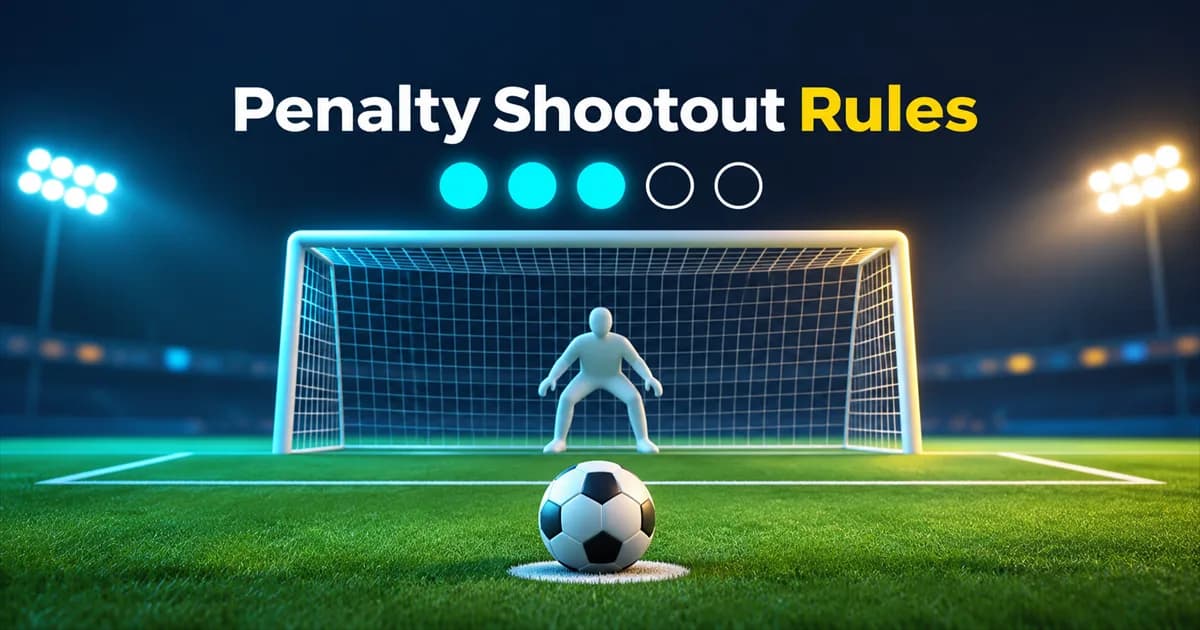
A penalty shootout works in two stages: 5 kicks per team, then sudden death. The referee tosses a coin to choose the goal, then tosses again, and the winner decides whether to kick first or second. The teams then kick alternately.
The first stage ends early when one team cannot be caught. A worked example with Team A kicking first:
| Round | Team A | Team B | Score | Position |
|---|---|---|---|---|
| 1 | Scores | Scores | 1-1 | Level |
| 2 | Scores | Misses | 2-1 | Team A leads |
| 3 | Misses | Scores | 2-2 | Level |
| 4 | Scores | Saved | 3-2 | Team A leads |
| 5 | Scores | Not taken | 4-2 | Decided |
After Team A's fifth kick the score is 4-2. Team B has 1 kick left, so its best possible total is 2 + 1 = 3, which is less than 4. The shootout ends and Team B's fifth kick is not taken.
Sudden death applies when the teams are level after 5 kicks each. The teams take one kick each until one has scored and the other has not from the same number of kicks. If both sides score 3 of their first 5, and in round 6 Team A scores and Team B misses, Team A wins 4-3.
Three more rules matter. The goalkeeper must have at least part of one foot on, in line with or behind the goal line when the kick is taken. The kicker cannot play the ball a second time, so there are no rebounds. A team with more players than its opponent must reduce its number to match, which is known as "reduce to equate".
How do extra time and penalty shootouts compare?
Extra time is more football, while a penalty shootout is a separate contest of kicks. The table shows the three stages of a knockout match.
| Stage | Length | Substitutions | Counts for most bets |
|---|---|---|---|
| Normal time | 2 x 45 minutes plus stoppage time | Set by the competition, commonly 5 | Yes |
| Extra time | 2 x 15 minutes plus stoppage time | Often 1 additional substitute | Only in markets that say so |
| Penalty shootout | 5 kicks each, then sudden death | Only for a goalkeeper who cannot continue | Only in markets that say so |
Extra time is played in full: the golden goal, which ended the match at the first goal, is no longer used.
Not every competition uses extra time. Some go straight to a shootout after 90 minutes, and two-legged ties have their own rules. The competition regulations state which method applies.
How do you follow a penalty shootout?
To follow a penalty shootout, track the score, the kicks each team has left and the order of kickers. Follow these steps:
- Check the competition rules to see whether extra time is played first.
- Note which team kicks first after the coin toss.
- Count the goals and the kicks taken by each team.
- Add each team's remaining kicks to its score to see whether it can still catch up.
- Watch for sudden death once both teams have taken 5 kicks and are level.
- Remember that all eligible players, including the goalkeeper, must kick before any player kicks again.
Bet settlement depends on the market. Suppose a cup final is 1-1 after 90 minutes, 2-2 after extra time, and Team A wins 4-2 on penalties.
- Match result: settles as a draw. A stake of 100 on the draw at odds of 3.20 returns 320, and bets on either team lose.
- Correct score and goalscorer: settle on 1-1 and on goals in normal time only. Shootout goals never count.
- Over 2.5 goals: loses, because only 1 + 1 = 2 goals came in normal time.
- To lift the trophy: a stake of 100 on Team A at odds of 1.80 returns 180.
- Method of victory: "Team A on penalties" wins.
Rules vary by bookmaker.
Common mistakes to avoid
- Assuming a match result bet includes extra time. The standard match result market settles on 90 minutes plus stoppage time.
- Expecting every shootout to last 10 kicks. A shootout ends as soon as one team cannot be caught.
- Counting shootout goals for goalscorer bets. Kicks from the penalty mark are not goals in the match.
Frequently asked questions
How many penalties are in a shootout?
A penalty shootout has 5 kicks per team in its first stage, so up to 10 kicks in total. It can end earlier if one team builds a lead the other cannot overturn. If the teams are level after 5 kicks each, they continue with one kick each until one team is ahead.
Who takes the first penalty in a shootout?
The team that wins the second coin toss decides whether to take the first or the second kick. The referee first tosses a coin to choose the goal, unless safety or pitch conditions decide it. Each team chooses its own order of kickers and does not have to announce it in advance.
Can a goalkeeper take a penalty in a shootout?
Yes, a goalkeeper can take a kick in a shootout, and must do so if the shootout lasts long enough. Every eligible player on a team, including the goalkeeper, takes one kick before any player takes a second. With 11 players per side, that point comes after 11 rounds.
Can a substitute take a penalty in a shootout?
A substitute can take a kick only if that player was on the pitch when the match ended. Players who were substituted off, unused substitutes and players who were sent off cannot take part. The one exception is a goalkeeper who cannot continue, who may be replaced if the team has substitutions left.
Do penalty shootout goals count in betting?
Penalty shootout goals do not count for match result, correct score, total goals or goalscorer markets, which settle on normal time. They decide markets such as "to qualify", "to lift the trophy" and "method of victory". Rules vary by bookmaker, so the football rules page is the place to check.
Play responsibly
A penalty shootout is close to a coin toss between evenly matched teams, so no result is predictable. Set a budget before the match and do not chase losses during extra time. Betting is for adults only, and the law differs by country. Support is available from GambleAware.
Summary
- Extra time is two halves of up to 15 minutes, used where competition rules provide for it.
- A penalty shootout is 5 kicks each, ending early when one side cannot be caught, then sudden death.
- Only players on the pitch at the end may kick, and all must kick before anyone kicks twice.
- Most bets settle on 90 minutes; "to qualify" and "method of victory" markets include extra time and penalties.
The full text is in the IFAB Laws of the Game. The 90-minute market is explained in 1X2 betting explained and correct score betting explained. Discipline is covered in yellow and red card rules, and another key law in the offside rule explained.
শুধু ১৮+। মজার জন্য খেলুন, নিজের সীমা ঠিক করে নিন, আর মজা না থাকলে বিরতি নিন।
পোস্টটি শেয়ার করুন