
Dragon Tiger Rules: How to Play, Odds and Payouts Explained
Bitdeposit · ১৭ নভেম্বর, ২০২৬ · 7 মিনিটে পড়া
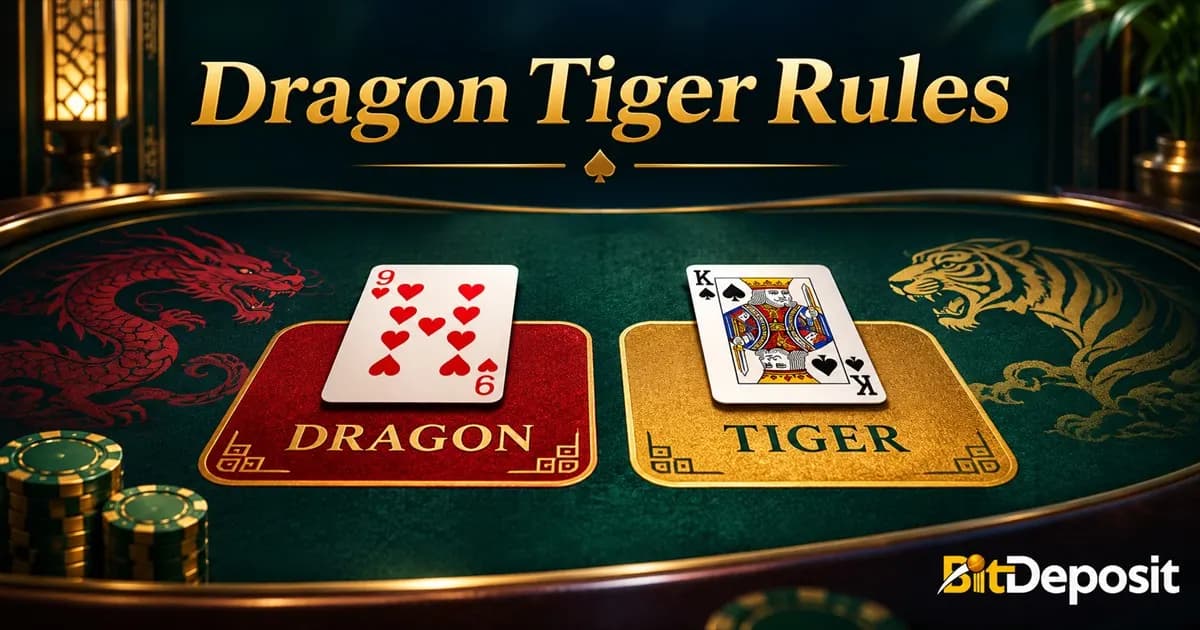
Dragon Tiger is a casino card game in which one card is dealt to a position called the Dragon and one to a position called the Tiger, and players bet on which will be higher. Aces are low and kings are high. It is one of the fastest and simplest casino games. This guide explains the rules and odds.
Key takeaways
- One card is dealt to the Dragon and one to the Tiger; the higher card wins.
- Cards rank from ace (lowest) to king (highest), and suits do not matter.
- Dragon and Tiger bets pay 1 to 1.
- If the two cards tie, Dragon and Tiger bets usually lose half the stake.
- The house edge is about 3.73% on Dragon and Tiger, and far higher on the Tie bet.
What is Dragon Tiger?
Dragon Tiger is a two-card game that originated in Cambodia and is popular across Asia. It is often described as a simplified version of baccarat, because players bet on one of two positions and take no further part.
The game is normally dealt from a shoe of six or eight decks. A round lasts only a few seconds, which makes it one of the quickest games in a live casino.
How do you play Dragon Tiger?
You play Dragon Tiger by betting on a position before the cards are dealt. A round follows these steps:
- Place a bet on Dragon, Tiger or Tie.
- The dealer burns one card, then deals one card face up to the Dragon.
- The dealer deals one card face up to the Tiger.
- The two cards are compared by rank.
- The higher card wins, and bets on that position are paid at 1 to 1.
- If the cards are equal in rank, Tie bets are paid and Dragon and Tiger bets are settled under the tie rule.
No extra cards are drawn, and there are no decisions to make after the bet.
Card ranking
Cards rank ace, 2, 3, 4, 5, 6, 7, 8, 9, 10, jack, queen, king, from lowest to highest. An ace is always low. Suits are ignored in the main bets.
What are the Dragon Tiger payouts and odds?
The table shows the main bets for a game dealt from eight decks.
| Bet | Wins when | Chance | Usual payout | House edge |
|---|---|---|---|---|
| Dragon | The Dragon card is higher | 46.26% | 1 to 1 | 3.73% |
| Tiger | The Tiger card is higher | 46.26% | 1 to 1 | 3.73% |
| Tie | Both cards have the same rank | 7.47% | 8 to 1 | 32.77% |
| Suited tie | Both cards have the same rank and suit | Under 2% | 50 to 1 | Very high |
A worked example with a stake of 100 on Dragon:
- The Dragon shows a king and the Tiger a 7: the profit is 100, and the total return is 200.
- The Dragon shows a 4 and the Tiger a 9: the stake of 100 is lost.
- Both show an 8: under the usual rule, 50 is lost and 50 is returned.
The house edge on Dragon and Tiger comes entirely from ties. Each position wins equally often, and the half-stake loss on a tie, which occurs about 7.47% of the time, produces the 3.73% edge.
What side bets are available?
Many tables offer side bets on a single card.
- Big or Small: whether the Dragon card, or the Tiger card, is above or below 7. A 7 loses.
- Odd or Even: whether a card's rank is odd or even. A 7 usually loses.
- Suit: the suit of the Dragon or Tiger card.
Side bets usually pay 1 to 1 or 3 to 1, and the losing 7 gives them a house edge of about 7.69%.
How do you work out your return?
To work out your return, compare the two cards and apply the payout. Follow these steps:
- Compare the ranks of the Dragon and Tiger cards, with the ace as the lowest.
- If your position has the higher card, your profit equals your stake.
- If the other position is higher, your stake is lost.
- If the ranks are equal, check the table's tie rule; usually half the stake is returned.
- For a Tie bet, multiply the stake by the payout shown, commonly 8.
Common mistakes to avoid
- Betting on the Tie. At 8 to 1, the Tie bet has a house edge of more than 30%.
- Treating the ace as high. The ace is the lowest card in Dragon Tiger.
- Following streaks. A run of Dragon wins does not make Tiger more likely.
- Ignoring the pace. Rounds take seconds, so many bets can be placed in a short time.
- Not checking the tie rule. Most tables return half the stake on a tie, but some take all of it.
Frequently asked questions
How do you win at Dragon Tiger?
You win at Dragon Tiger by betting on the position that receives the higher card. If you bet on Dragon and its card outranks the Tiger's, you are paid at 1 to 1. The result is pure chance, so no strategy changes the odds of winning.
What happens on a tie in Dragon Tiger?
On a tie in Dragon Tiger, bets on the Tie are paid, usually at 8 to 1. Bets on Dragon and Tiger normally lose half the stake, and the other half is returned. A few tables take the whole stake, so check the rule before playing.
Is the ace high or low in Dragon Tiger?
The ace is low in Dragon Tiger. It is the lowest-ranked card and loses to every other rank. The king is the highest card. This differs from many poker games, where the ace is normally the highest card. If both positions are dealt an ace, the round is a tie.
What is the best bet in Dragon Tiger?
The best bet in Dragon Tiger is Dragon or Tiger. Both have the same house edge of about 3.73%. The Tie bet and the side bets carry a much higher edge, so they cost more over time despite their larger payouts.
What is the difference between Dragon Tiger and baccarat?
Dragon Tiger deals one card to each side and compares them directly, while baccarat deals two or three cards to each side and compares totals. Baccarat's main bets have a lower house edge, about 1.06% to 1.24%, against 3.73% in Dragon Tiger.
Play responsibly
Knowing the rules and the odds helps you make informed decisions, but Dragon Tiger is a game of chance, and its speed makes it easy to lose track of spending. Set a budget before you start, never stake money you cannot afford to lose, and take a break if playing stops being enjoyable. Gambling is for adults only, and you should check that it is legal where you live. Independent support is available from organisations such as GambleAware.
Summary
- One card each to Dragon and Tiger; the higher card wins.
- Ace is low, king is high, and suits are ignored.
- Dragon and Tiger pay 1 to 1 with a house edge of about 3.73%.
- The Tie bet has a very high house edge.
The closest relative of this game is explained in the baccarat rules explained. Another simple card game is covered in the Andar Bahar rules, and a dice alternative in the Sic Bo rules.